Six acts in an afternoon
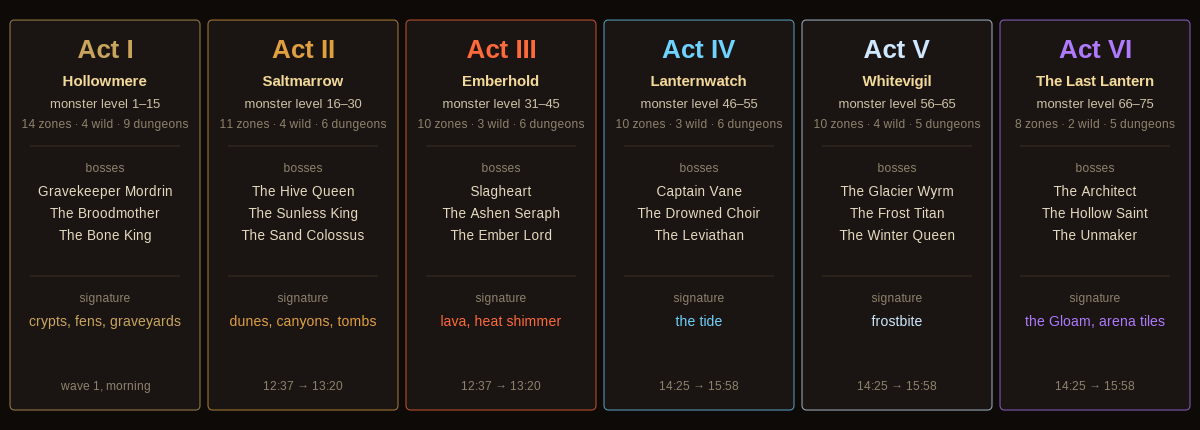
Six acts, 63 zones, 34 biomes and 18 bosses, built by three parallel agents per batch working from a vocabulary-first commit.
Contents
Act I shipped with the engine in the morning, Acts II–III at 13:20, and Acts IV–VI launched at 14:25 and merged at 15:58. What kept them distinct was ordering and data: vocabulary first, then three agents per batch that never touched each other's files.
Vocabulary first
Every act adds words (biomes, tile kinds, props, monsters) that every layer depends on: generators place a lighthouse, the manifest maps it to a model, the renderer lights it, nav gives it a footprint. So each batch started with a vocabulary-only commit. For Acts IV–VI, 96 lines in shared/constants.ts:
export const TileKind = {
  // …
  Lava: 10, // blocks movement, not sight; emits light (Act 3)
  Sand: 11, // walkable desert sand (Act 2) — renders by biome like Floor
  Ice: 12, // walkable ice sheet (Act 5) — renders by biome, glossy
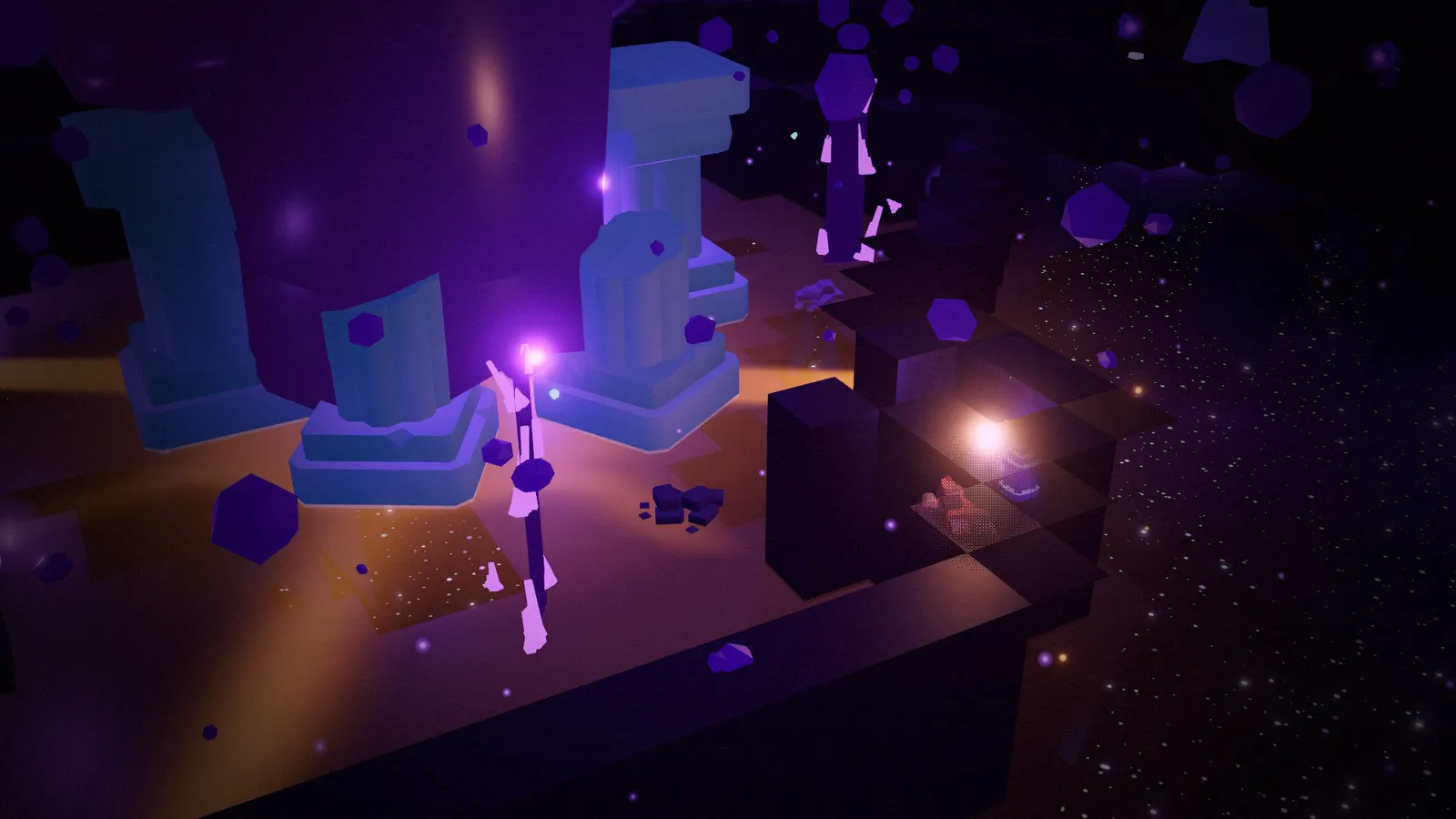
  Abyss: 13, // Act 6 starfield void between floating isles — blocks movement, not sight
} as const

export const BIOME_IDS = [
  // …
  // Act 4 — the Hollow Sea (storm coast)
  'town_lanternwatch', // lighthouse harbor town on stilts and docks, storm lanterns
  'storm_coast', // black-sand beaches, sea stacks, tide pools, driftwood, crashing surf
  'shipwreck_shoals', // shallows strewn with wrecks, masts, nets, barnacled rocks
  'kelp_forest', // drowned forest: towering kelp, coral, bioluminescence
  'drowned_cathedral', // flooded gothic cathedral dungeon: pews in water, bells, stained light
  'tide_caves', // bioluminescent sea caves: glowing pools, coral, shells
  // Act 5 — the Frostbound Spires (glacier kingdom)
  // …
  // Act 6 — the Gloam (the void, the finale)
  'town_last_lantern', // a floating monastery isle, a single great lantern
  'shattered_isles', // floating rock islands over a starfield abyss, chain bridges
  // …
] as const
The comments are the brief for all three agents:
- Worlds (W456): generators and renderer presets, three towns, sea and ice terrain, two dungeon layouts
- Content (C456): zones, monsters, bosses, quests, items, NPCs, server side of each mechanic
- Assets (A456): Kenney models, recoloured skins, composite props
Where they met (the tide renderer, say), content wrote a minimal version marked replaceable by worlds.
A zone is a row of data
{
  id: 'a1_blighted_fields', name: 'The Blighted Fields', act: 1, kind: 'wilderness', biome: 'blight_fields', level: 2, size: { w: 144, h: 144 },
  monsterPool: [
    { monster: 'zombie', weight: 35 }, { monster: 'plague_rat', weight: 20 }, { monster: 'gloom_bat', weight: 10 },
    { monster: 'blightwolf', weight: 15 }, { monster: 'bog_slime', weight: 8 },
  ],
  density: 0.3, waypoint: true, championChance: 0.08, uniqueChance: 0.04,
  questHooks: ['a1_blight_at_the_gate'],
  exits: [
    exit('to_town', 'a1_town', 'to_fields', 'edge', 'To Hollowmere', 'south'),
    exit('to_graveyard', 'a1_hollow_graveyard', 'to_fields', 'edge', 'To the Hollow Graveyard', 'north'),
    exit('to_chapel', 'a1_sunken_chapel_1', 'to_fields', 'stairs_down', 'The Sunken Chapel'),
    exit('to_warren', 'a1_rat_warren', 'to_fields', 'stairs_down', 'The Rat Warren'),
  ],
},
Exits come in named pairs; a data test checks every exit is bidirectional and kinds pair up (stairs down ↔ stairs up). zoneDefToGenInput hands the row to the generators.
Every act follows one pattern:
- Town: waypoint, stash, healer, smith, quest giver
- Three or four wildernesses in a loose chain
- Five to nine dungeons, mostly two or three floors, off the wilds by stairs
- Three bosses; the act boss's quest grants the next town's waypoint
| Act | Monster levels |
|---|---|
| I | 1–15 |
| II | 16–30 |
| III | 31–45 |
| IV | 46–55 |
| V | 56–65 |
| VI | 66–75 |
Zone level drives monster stats, drop item level and nearby vendor stock.
Towns are templates, the wilds are not
All six towns are hand-authored 64 × 64 templates seeded by zone id alone: two Saltmarrows are identical to the lamp post.
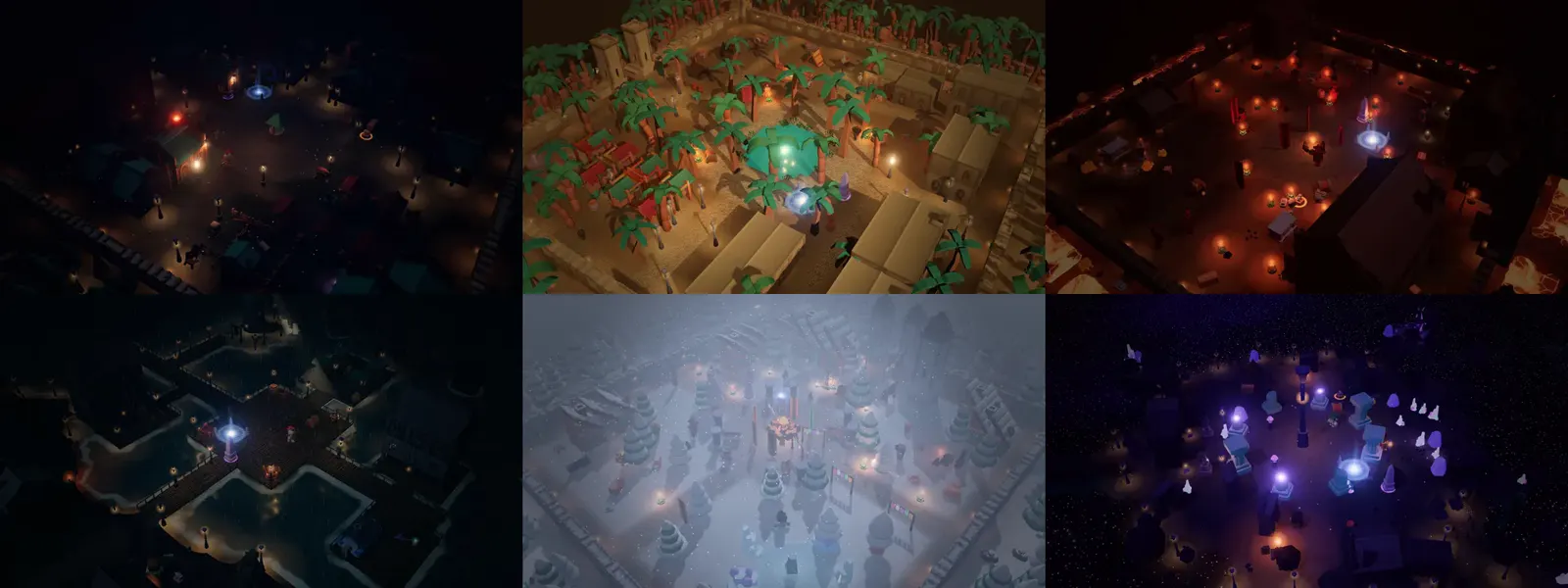
Mood is mostly lighting. One preset entry per biome sets fog, ambient, hemisphere, moon, player light, exposure, bloom, grade, particles, weather and extras:
frost_wastes: {
  fog: 0xa4b4c6,
  fogDensity: 0.03,
  ambient: { color: 0x8a98b0, intensity: 0.8 },
  hemi: { sky: 0xd8e6f6, ground: 0x505a6c, intensity: 0.75 },
  moon: { color: 0xeef4ff, intensity: 1.4, elevationDeg: 32, azimuthDeg: 250 },
  playerLight: { color: 0xffb070, intensity: 7.5, radius: 9 },
  exposure: 0.9,
  bloom: { strength: 0.4, radius: 0.55, threshold: 0.9 },
  grade: { lift: [0.02, 0.03, 0.06], gain: [0.98, 1.0, 1.05], saturation: 0.72, vignette: 0.5, grain: 0.04 },
  wind: 'wind',
  motes: { color: 0xf4f8ff, count: 170, style: 'sand' },
  weather: { kind: 'blizzard', density: 1, wind: [7.5, 2.4] },
  reflect: 0.25,
  breath: true,
},
Wild variety comes from generator parameters and dressing. Kelp forest and storm coast share the wilderness generator: one floods most ground with shallows and grows coral, the other carves black-sand beaches and sea stacks. The dungeon generator has 13 biomes, each with room names, torch colour, props and boss room name.
A signature per act
Acts I–III differ by place. Acts IV–VI each add a movement rule, server-driven and broadcast as compact state; the client derives the rest from the map.
Act IV, the tide
| Phase | Duration |
|---|---|
| Low | 40 s |
| Rising (bell) | 6 s |
| High | 22 s |
| Ebbing | 5 s |
At high tide, low ground within three tiles of water floods: players wade at 65% speed, aquatic monsters in it deal +35% damage and move +30% faster, and up to four drowned sailors come out of the surf.
The flood mask is a BFS out from water computed by shared floodMask. The schema carries two numbers:
/** acts: tide phase index into TIDE_PHASES (shared/data/actMechanics), 255 = no tide in this zone */
tide: t.uint8().default(255),
/** acts: serverTime the current tide phase began */
tideAt: t.uint32().default(0),
Maps wetter than 35% (shoals, kelp forest) only seed the flood from their deepest quarter of water, or they'd drown entirely.
Act V, frostbite
- Meter 0–100, builds 2.2/s away from warmth (~45 s to full)
- Thaws 28/s within five tiles of a bonfire, campfire, brazier, fire pit, forge or wall torch
- Cold resistance slows the build, to half speed at 75
- 50: −10% speed; 75: −20%; 100: −30% and 0.5% life/s bleed
Crossing the Frost Wastes becomes camp to camp. On the wire it's one uint8 per player; the speed penalty is just the player's speed, which prediction already reads.
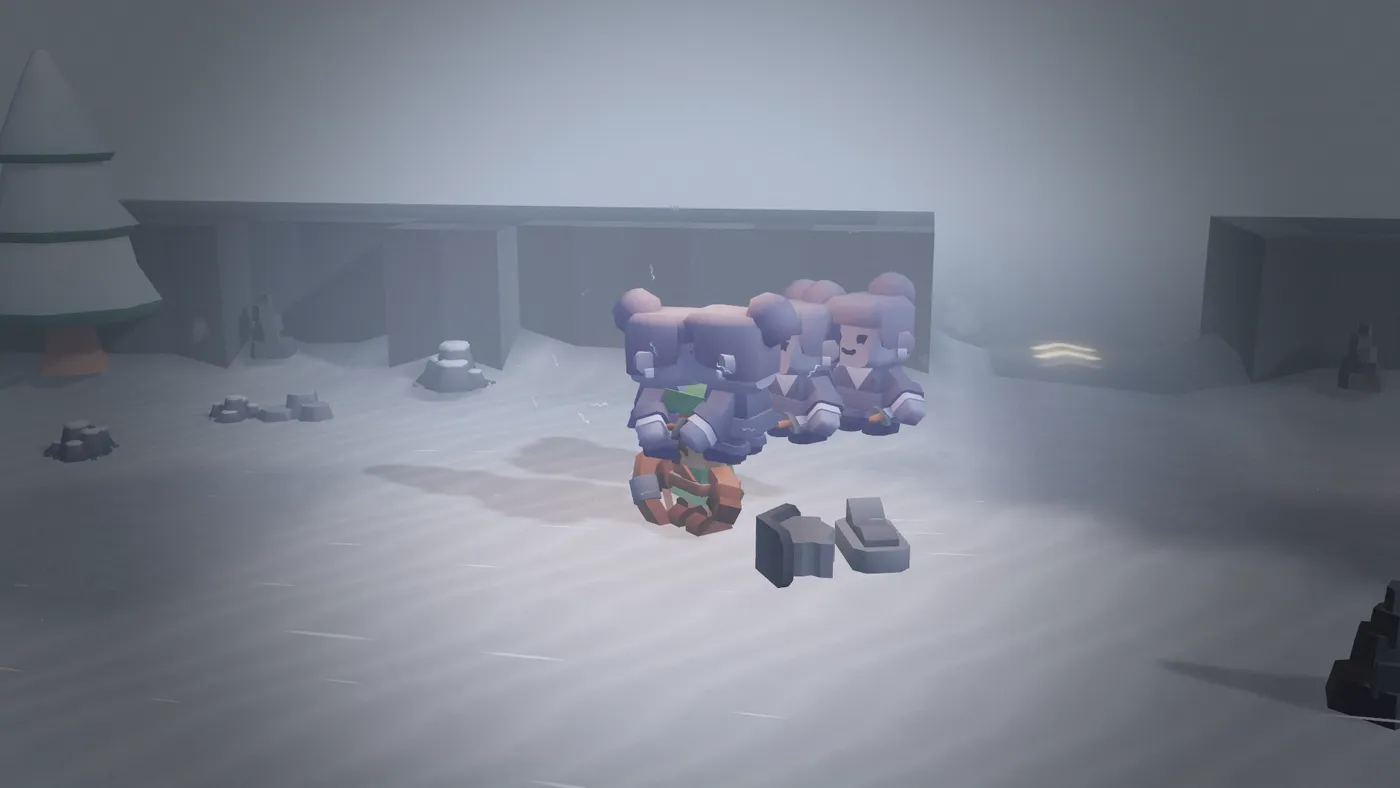
Act VI, the Gloam and the arena
Gloam eyes, the Hollow Saint and the Unmaker can Gloam you: vision closes to 4.5 tiles for a few seconds (an expiry time on the player, a vignette on the client).
The bigger change: the floor moves. The Architect and the Unmaker stamp walls, abyss, flood and warning tiles into named server layers (current pattern, next-pattern warning, bone prisons, collapsing edge, floods), composited by priority straight into the nav grid. Units on a tile that stops being walkable are pushed out; a player the floor drops from under loses 20% life.
/** `index` (base 36) + code, comma-separated, sorted by index so identical layouts encode identically. */
export function encodeDynTiles(tiles: ReadonlyMap<number, DynTile>): string {
  return [...tiles.entries()]
    .sort((a, b) => a[0] - b[0])
    .map(([i, t]) => `${i.toString(36)}${DYN_CODE[t]}`)
    .join(',')
}
Three or four characters per tile; sorted so an unchanged layout produces no patch. The client stamps the same tiles into its prediction grid, so paths reroute the instant a wall appears. A test checks no arena pattern splits the arena.
The Unmaker plays the whole campaign back
Eight phases. After the opening, each borrows an earlier boss's signature and says so:
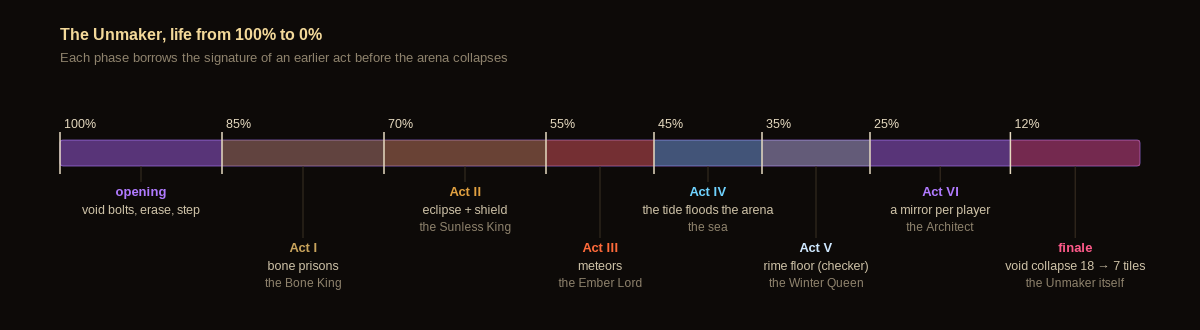
{
  atLifePct: 45, abilities: ['um_erase', 'um_void_bolts', 'um_step'], speedMult: 1.1, dmgMult: 1.15, attackSpeedMult: 1.1,
  yell: 'The sea drained into me once. It can do it again.',
  summonOnEnter: { monster: 'drowned_sailor', count: 3 }, hazard: { ability: 'um_tide', count: 2 },
  specials: [{ kind: 'flood', radius: 20, durationMs: 12000, everyMs: 20000 }],
},
// …
{
  atLifePct: 12, abilities: ['um_erase', 'um_void_bolts', 'um_unmake'], speedMult: 1.35, dmgMult: 1.35, attackSpeedMult: 1.35,
  yell: 'ENOUGH ECHOES. Let there be nothing, and let it be quiet.',
  hazard: { ability: 'um_void_rifts', count: 4 },
  specials: [{ kind: 'void_collapse', fromRadius: 18, toRadius: 7, stepMs: 4000 }],
},| Phase mechanic | Reused machinery |
|---|---|
| Bone prison | Architect's wall layer, ringed around a player |
| Flood | the tide's water as an arena layer |
| Rime floor | checkerboard hazard pattern |
| Mirrors | one mirror knight per player, copying their class |
| Void collapse | walkable radius 18 → 7 in 4 s steps |
Everything fires through castTriggered, the one path for non-button skills, so a new phase is data, not code. On death: a server-wide announcement, the Lanternbearer title, and an epilogue from Marrow's Echo.
Keeping six acts balanced
Each batch shipped balance tables as tests: a geared hero of the act's level vs its monsters and bosses, asserting hits-to-die, time-to-kill and boss kill times. Acts IV–VI cover levels 50, 60 and 70.
- Damage stops compounding at 45. Player life is roughly linear; before the cap, level-70 packs two-shot geared heroes.
- XP steepens past 75: level 99 takes ~1.96 billion.
- Early taper: fresh characters died too fast in the Blighted Fields, so monster damage ramps from 40% at level 1 to 100% at 16, where Act II starts. A test pins the curve.
- Nightmare and Hell reuse all 63 zones with per-stat fitted rescaling that keeps each monster's identity. See the endgame.
What it adds up to
| Zones | 63 (6 towns, 20 wilds, 37 dungeon floors) |
| Biomes | 34 |
| Monster types | 109 |
| Bosses | 18, with 2–8 phases |
| Finale titles | one per act from Act III |
What makes Act V feel different from Act II is mostly a preset entry and a rule about fire. The part I'd reuse: vocabulary in its own commit, three owners in parallel, contracts as data types.
Read next
- From Kenney kits to a cohesive world: where every lighthouse and snow cabin came from
- Worlds from a seed: the generators behind every zone in this post
- Plain Three.js, pushed hard: the sea, the weather and the aurora