Worlds from a seed
Every map is generated from a zone id and a 32-bit seed, byte-identical on server and browser, so no tile ever crosses the wire.
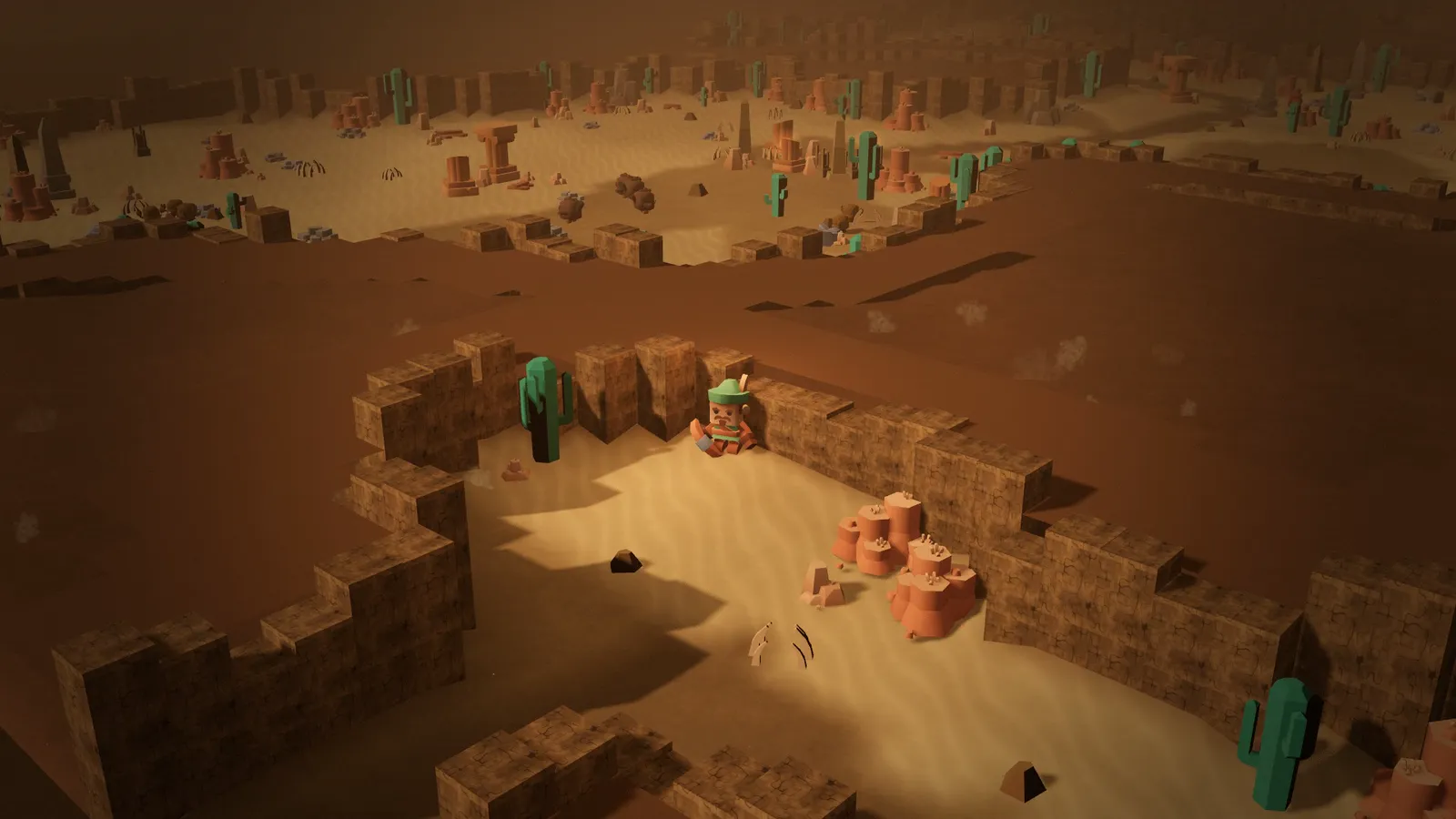
Contents
A zone is up to 176 × 176 tiles, over a thousand props, up to a couple of hundred lights and 68 spawn points. None of it goes over the network: the server sends a zone id and one uint32, and the browser builds the same map bit for bit.
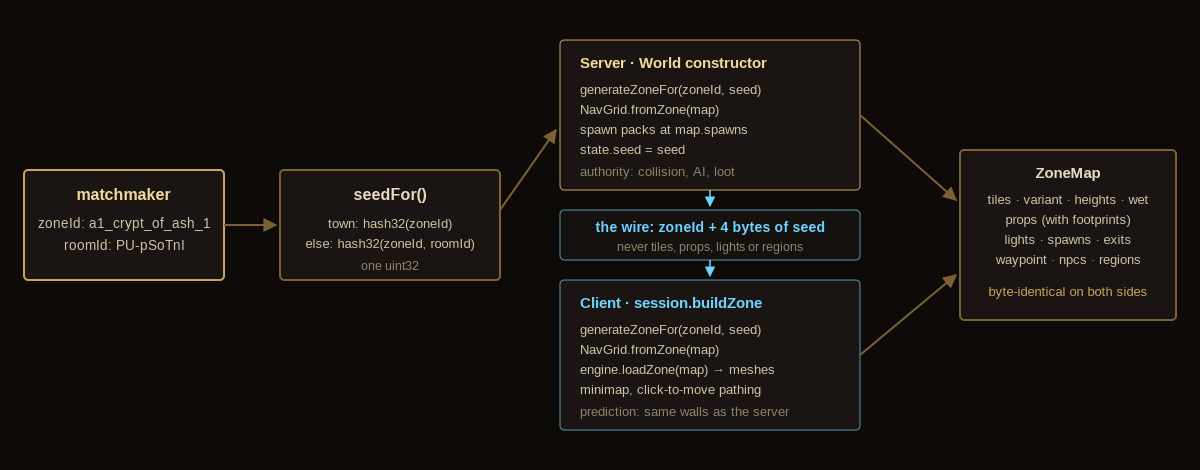
Why not send the map
- Size. Tiles, variants and heights for a 176 × 176 wilderness are ~186 KB before props, which are thousands more records. Every zone change would stall on a download.
- The client needs it anyway. Movement prediction collides against the same walls as the server, click-to-move pathfinds locally, and the minimap reads the same tiles.
The price is discipline: procgen must be pure. No Math.random, no Date.now, no unspecified iteration order, no engine-dependent float shortcuts. shared/procgen and shared/nav have no DOM and no node:* imports; both sides import the same modules.
A seeded RNG, forked by purpose
sfc32, seeded through a string hash so seeds can be built from readable labels:
/** 32-bit string/number hash (FNV-1a variant, then avalanche). */
export function hash32(...parts: Array<string | number>): number {
  let h = 0x811c9dc5
  for (const part of parts) {
    const s = typeof part === 'number' ? String(part) : part
    for (let i = 0; i < s.length; i++) {
      h ^= s.charCodeAt(i)
      h = Math.imul(h, 0x01000193)
    }
    h ^= 0x7c // separator so hash32('ab','c') !== hash32('a','bc')
    h = Math.imul(h, 0x01000193)
  }
  h ^= h >>> 16
  h = Math.imul(h, 0x85ebca6b)
  h ^= h >>> 13
  h = Math.imul(h, 0xc2b2ae35)
  h ^= h >>> 16
  return h >>> 0
}

export class Rng {
  /** Derive an independent child stream (e.g. per-room, per-feature). */
  fork(label: string | number): Rng {
    return new Rng(hash32(this.nextU32(), label))
  }
  // nextU32, next, range, int, chance, pick, shuffle…
}Math.imuland>>> 0keep everything in 32-bit integers: no floats to disagree about.- The MurmurHash3 finalizer spreads near-identical inputs like
a1_crypt_of_ash_1and_2. forkgives each stage its own stream ('rooms','props','spawns'). One extra random call in the room stage changes only rooms, not every chest downstream.
Seeds come from the room:
export function seedFor(zoneId: string, roomId: string): number {
  return zoneId.endsWith('_town') ? hash32(zoneId) : hash32(zoneId, roomId)
}
Towns are always the same town, so players learn where the stash is. Everything else mixes in the Colyseus room id: two parties get two crypts, and a disposed-and-recreated room is a new crypt. The seed rides the schema as a uint32 in the first patch.
Four generators, one contract
// Public procgen API. generateZone is PURE + DETERMINISTIC: same input → byte-identical output.
export function generateZone(input: ZoneGenInput): ZoneMap {
  switch (input.kind) {
    case 'town':
      return generateTown(input)
    case 'wilderness':
      return input.biome === 'shattered_isles' || input.biome === 'astral_garden' ? generateIsles(input) : generateWilderness(input)
    case 'dungeon':
      return generateDungeon(input)
  }
}| Generator | How |
|---|---|
| Town | hand-authored 64 × 64 template per act, seeded decoration jitter, shared kit for gates, wall torches, NPC spots |
| Wilderness | key points (exits, waypoint, clearings) → MST plus a few loop edges → midpoint-displaced trails → noise-carved ground bounded by cliffs or tree walls → roads, ponds, bridges, dressing, spawns. 1,924 lines |
| Dungeon | rectangles or cellular-automata caves, MST corridors plus ~15% loops, modular walls; boss room = farthest walk from entrance. Mirror Halls (symmetric) and Gloam Heart (spiral) use fixed layouts |
| Isles | Poisson-scattered noisy blobs over a starfield, MST chain bridges, unreachable islands pruned (Shattered Isles, Astral Garden) |
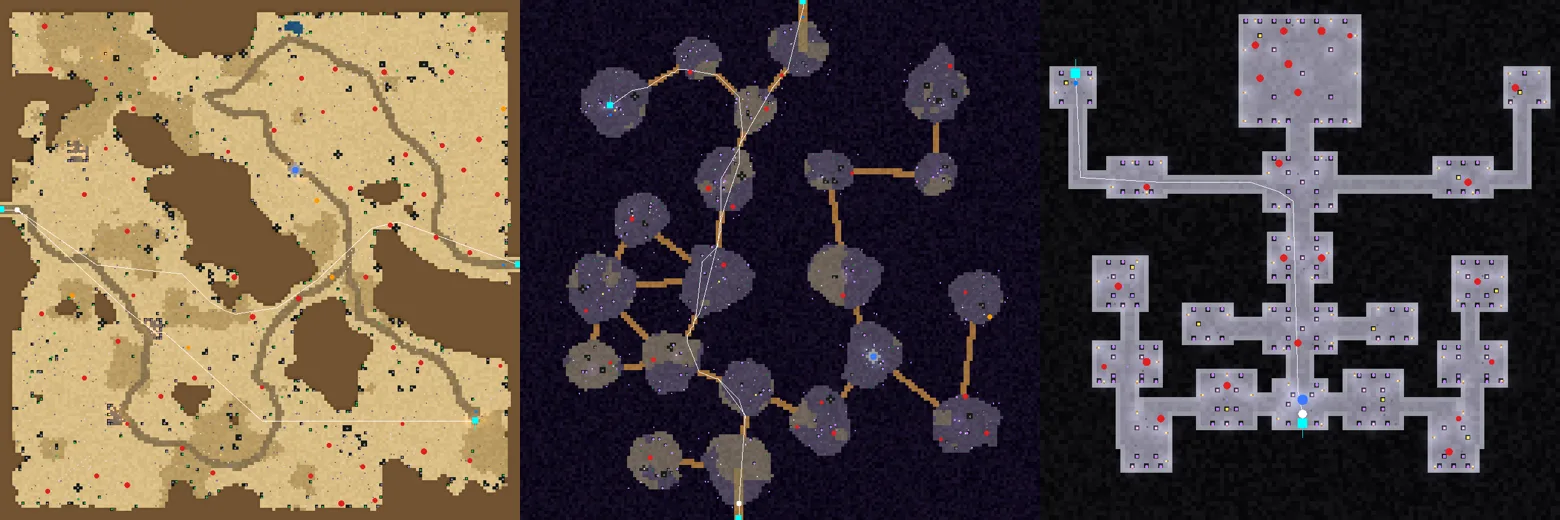
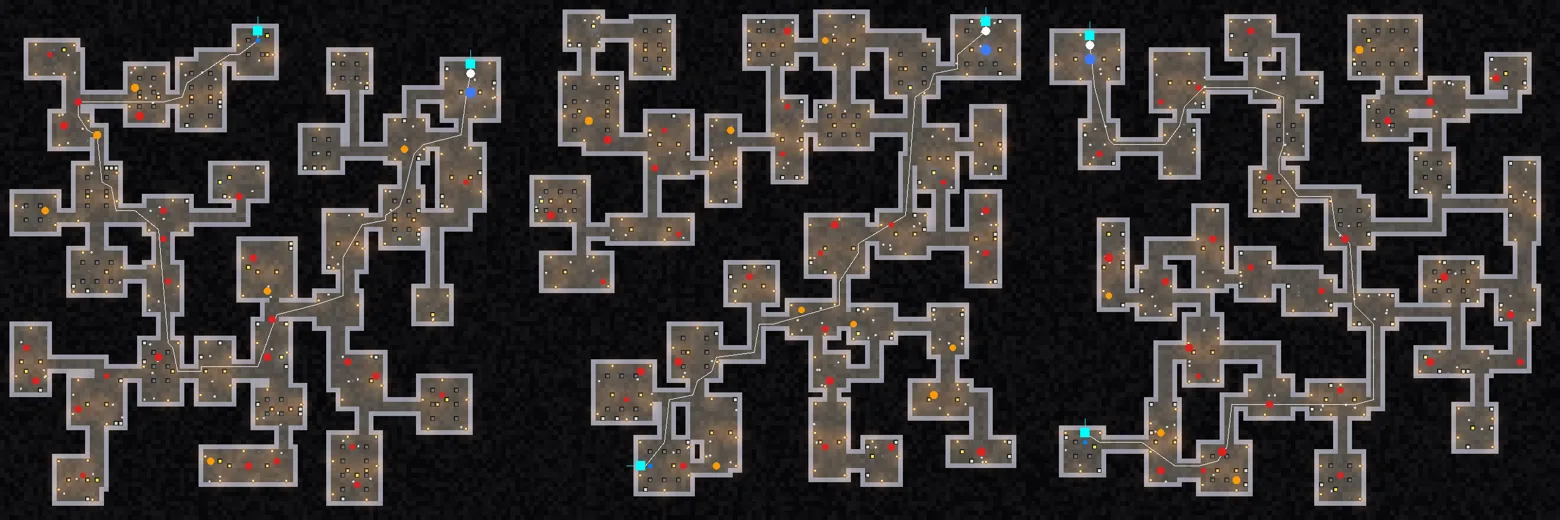
Wilderness and dungeons also BFS every tile's walking distance from the entrance. Spawns use it to keep packs off the entrance and weight them toward the far end, stored as depth in 0..1. Because it's walking distance, a loop-corridor shortcut counts as close.
Props that can't block the way
The classic procgen bug is a barrel sealing the only corridor. Instead of generate-test-repair, every blocking prop goes through a Placer that only accepts placements that keep connectivity:
// Connectivity-safe prop placement.
//
// Blocking props are rasterized with the same footprint rule as NavGrid. Nav is 8-dir with no
// corner cutting, whose reachability equals 4-connectivity, so blocking a set of tiles is safe iff
// all walkable 4-neighbours of that set stay mutually connected. Checked in increasing cost: the
// local 3×3 simple-point test (single tiles), a BFS confined to a window around the footprint,
// then (multi-tile footprints only) a full-grid BFS. Every accepted placement preserves global
// connectivity by construction, so generators never have to repair maps afterwards.
The first check is digital topology: a tile is a simple point if its walkable orthogonal neighbours all fall in one run around its 8-ring, so blocking it disconnects nothing.
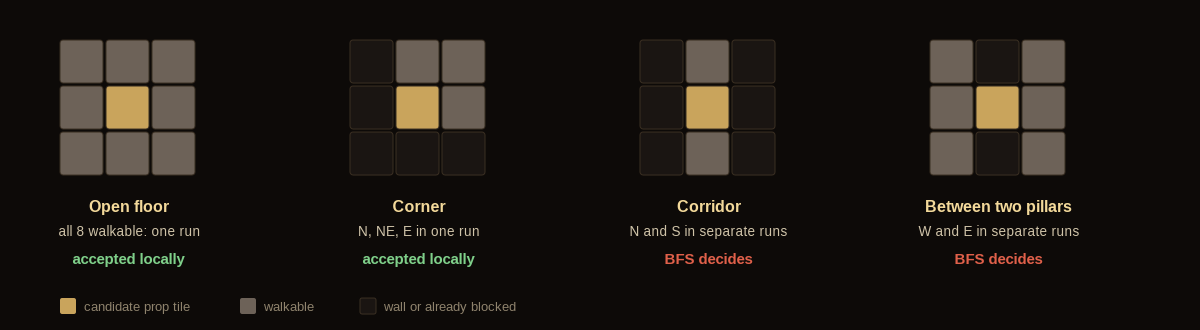
- Most placements are single tiles on open ground and pass in a few dozen instructions.
- The rest get a windowed BFS; multi-tile footprints get a final full-grid BFS.
- The footprint rule matches the nav grid exactly (blocked if the tile center is strictly inside the prop's shape), so they can't disagree.
- Paths, exit approaches, the waypoint disk and NPC spots are reserved before decorating.
A nav grid both sides share
NavGrid.fromZone builds two byte layers: walk and sight. Water and chasms block walking, not arrows; towers block both.
- A*: 8-directional, no corner cutting, octile heuristic, indexed binary heap, zero per-node allocation. A node budget returns a partial path; a line-of-sight pass pulls the string.
- Line of sight: grid DDA (Amanatides and Woo). Exact corner crossings need both side tiles clear.
walkableSegment: center line plus two rails offset by agent radius.- Distance fields: bounded Dijkstra from one tile.
150 monsters chasing 40 players can't each run A* whenever a target moves. Three tiers:
/** Move toward `t` until within `stopAt`. Direct steering when the line is clear, else the shared
 *  distance field toward that player (one Dijkstra per target shared by the whole crowd), else A*. */
function approach(w: World, m: SimMonster, t: Unit, dtMs: number, stopAt: number): void {
  // …
  const direct = d < 12 && walkableSegment(w.nav, m, { x: gx, y: gy }, 0.2)
  if (direct) { /* steer straight at the target */ return }
  if (t.kind === 'player') {
    const f = w.fieldFor(t)
    const dir = f ? f.direction(m.x, m.y) : null
    if (dir && (dir.x !== 0 || dir.y !== 0)) { /* follow the field downhill */ return }
  }
  if (m.path.length === 0 || now >= m.nextPathAt) {
    m.nextPathAt = now + 700 + w.rng.int(0, 300)
    if (!w.budgetPath()) return
    pathTo(w, m, t.x, t.y, 1500)
  }
  // …
}- Direct: target within 12 tiles, clear line: walk at it.
- Shared field: one field per chased player, rebuilt on tile change at most 4×/s, flooding 40 tiles.
- A*: capped at 10 searches per room per tick, with jittered repath timers.
| Nav operation (test suite, this machine) | Time |
|---|---|
| A* path (507 nodes expanded) | 0.067 ms |
| Distance field build | 0.042 ms |
| Nav grid, largest zone | < 1 ms |
The client predicts on the same grid, so its position and the server's almost always agree. See Twenty ticks a second.
Testing determinism and connectivity
Every sample input is generated twice at three seeds and compared byte for byte; two different seeds must differ (except towns):
describe('determinism', () => {
  for (const input of SAMPLE_INPUTS) {
    test(input.id, () => {
      for (const seed of [1, 42, 0xdeadbeef]) {
        const a = generateZone({ ...input, seed })
        const b = generateZone({ ...input, seed })
        expect(Buffer.from(a.tiles).equals(Buffer.from(b.tiles))).toBe(true)
        expect(Buffer.from(a.variant).equals(Buffer.from(b.variant))).toBe(true)
        expect(a.props).toEqual(b.props)
        expect(snapshot(a)).toBe(snapshot(b))
      }
      // …
    })
  }
})
validateZone runs over 50 seeds per sample: from a walkable start, a 4-connected BFS must reach every exit, arrival point, the waypoint, every NPC, every interactive prop, the boss spawn and every region center. A second suite does it for every biome at several depths and sizes.
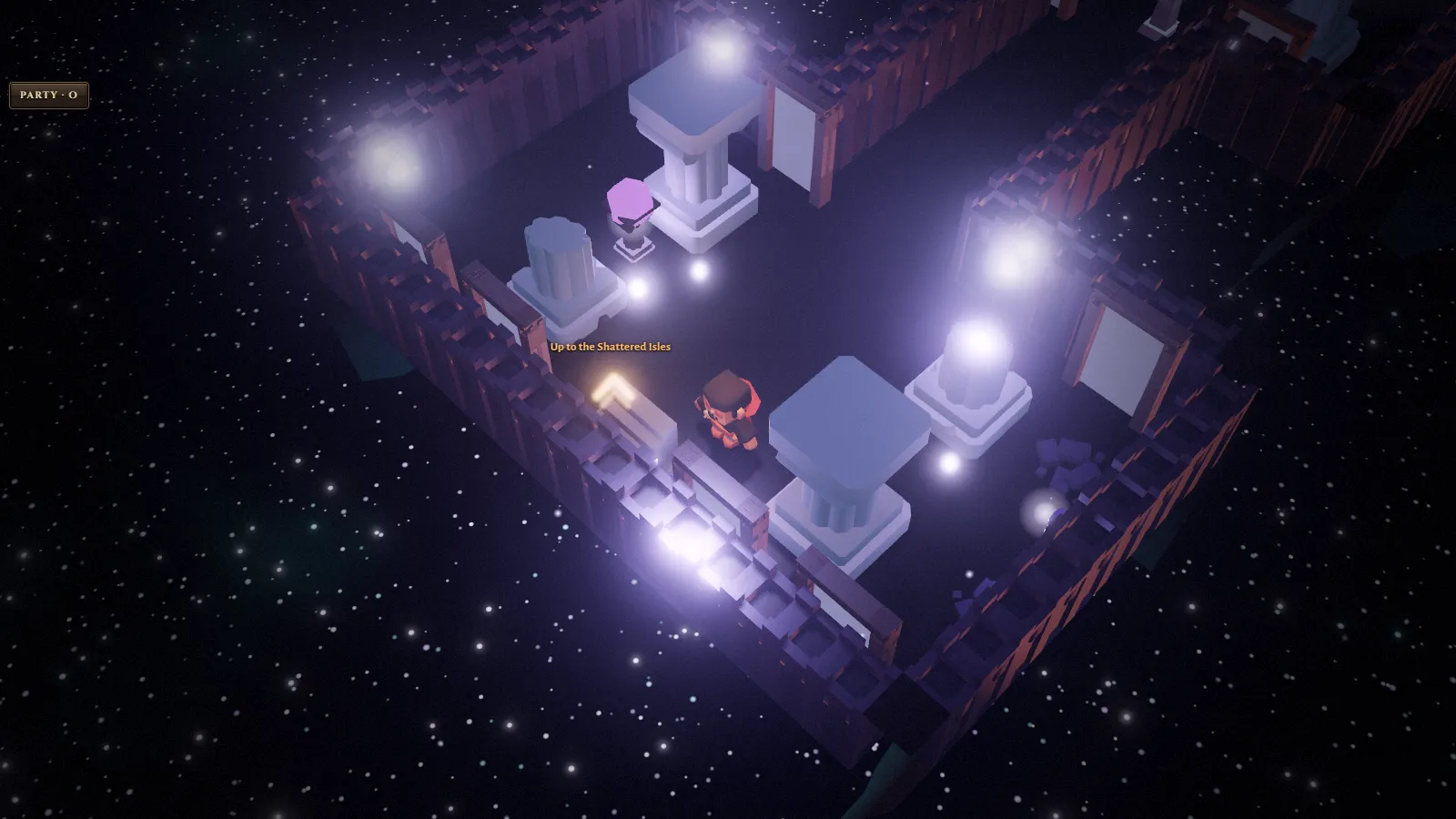
scripts/procgen-preview.ts renders any sample and seed to PNG with A* paths to every exit. Every map image in this post came from it.
The budget
50 ms for the largest maps. A room generates synchronously in the World constructor, on the thread every room shares; the client pays it behind a loading screen.
Medians of nine seeds on a busy dev machine:
| Zone | Kind | Size | Generate | Nav grid | Props | Lights |
|---|---|---|---|---|---|---|
| Hollowmere (Act I town) | town | 64 × 64 | 2.0 ms | 0.09 ms | 500 | 74 |
| Crypt of Ash, level 1 | dungeon | 104 × 104 | 1.6 ms | 0.04 ms | 364 | 147 |
| Drowned Cathedral, level 1 | dungeon | 120 × 120 | 5.9 ms | 0.15 ms | 461 | 212 |
| Mirror Halls, level 1 | dungeon | 120 × 120 | 3.1 ms | 0.27 ms | 343 | 130 |
| Blighted Fields | wilderness | 144 × 144 | 29.5 ms | 0.26 ms | 973 | 38 |
| Shattered Isles | islands | 176 × 176 | 23.7 ms | 0.12 ms | 544 | 20 |
| Scorched Dunes | wilderness | 170 × 170 | 48.8 ms | 0.26 ms | 1,260 | 9 |
| River of Flame | wilderness | 176 × 176 | 52.7 ms | 0.31 ms | 1,328 | 144 |
Dungeons are mostly void and cheap. Big wildernesses (noise per tile, trails, 1,000+ Placer calls) sit at the 50 ms line when loaded, under it when idle; the perf test uses a median of five. Next step if they grow: cache maps by (zoneId, seed) on the server.
What the seed doesn't cover
Combat, loot and AI use a separate clock-seeded RNG per room and are server-only; the client never predicts a drop or crit. Spawn points come from the map; which monsters, affixes and packs appear is server state.
The rule for the whole codebase: derivable from zone id and seed → derived on both sides. Depends on what players do → server, then sent.
Read next
- Six acts in an afternoon: how the generators were bent into 34 biomes and six acts
- Twenty ticks a second: what the server does with the map once it has one
- Plain Three.js, pushed hard: how the client turns a ZoneMap into meshes