One process, one port, forty players
One Bun process serves SSR pages, the tRPC API and Colyseus game rooms on a single port, with Vite HMR sharing it in development.
Contents
Pages, tRPC, matchmaking and every game websocket run in one Bun process on one port: bun --watch server.ts on 4477 in dev, bun server.ts in a container in prod. No separate game server, gateway or sidecar.
The starter template already put Express, Vite SSR and tRPC on one port. Colyseus fits in the same process only if it's wired in by hand instead of owning the HTTP server.
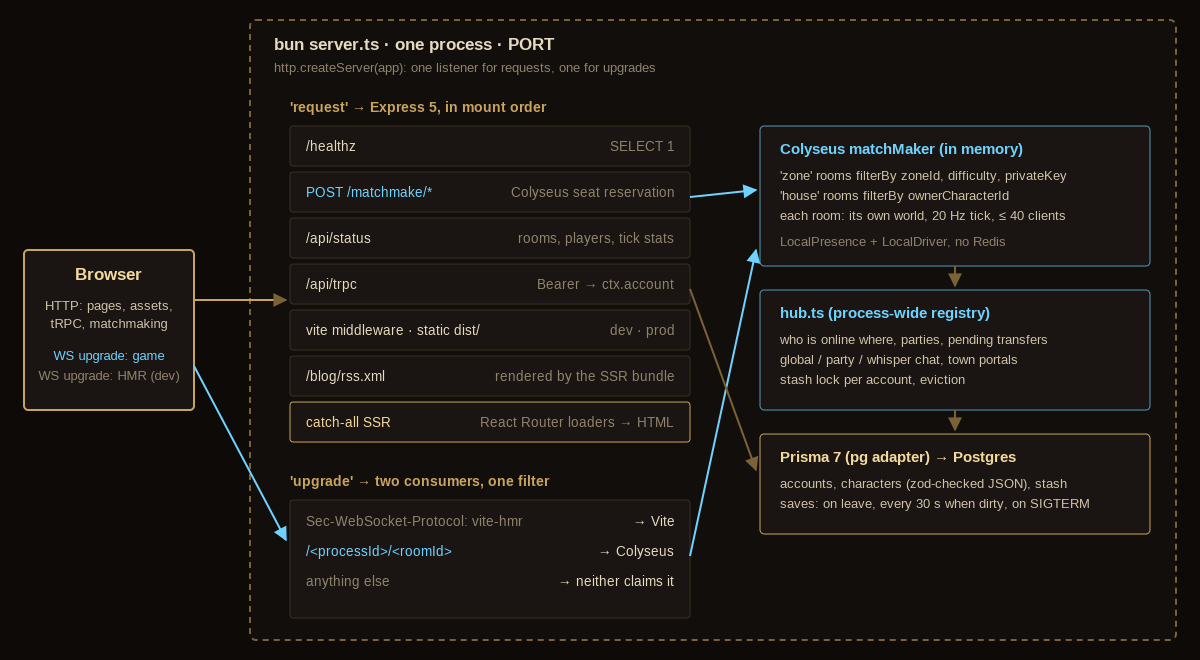
The mount order is the architecture
const app = express()
const httpServer = http.createServer(app)

app.get('/healthz', async (_req, res) => { /* SELECT 1 */ })

// Colyseus: websocket upgrades on /<processId>/<roomId> + HTTP matchmaking on /matchmake/*
const game = await createGameServer(httpServer)
app.use(game.matchmaking)

app.get('/api/status', async (_req, res) => res.json(await gameStatus()))
app.use('/api/trpc', createExpressMiddleware({ router: appRouter, createContext }))

if (!isProd) {
  vite = await createViteServer({ server: { middlewareMode: true, hmr: { server: httpServer } }, appType: 'custom' })
  app.use(vite.middlewares)
} else {
  app.use(compression(), express.static('dist/client', { index: false, redirect: false }))
}

app.get('/blog/rss.xml', /* rendered from the SSR bundle */)
app.use(/* SSR catch-all */)

httpServer.listen(PORT)- Non-page endpoints go before the catch-all, which renders React Router for any extension-less GET.
- The catch-all refuses what it shouldn't render.
/api/*misses get a JSON 404; anything with a file extension gets a plain 404. A missingfavicon.icoshouldn't cost a React render. - Vite xor static. Dev: Vite middleware plus HMR on our
httpServer. Prod: compresseddist/client, a year ofimmutablecaching on hashed/assets. redirect: falseexists for this blog. Without it,serve-staticseespublic/blog/<slug>/and answers301 → /blog/<slug>/before SSR runs, in prod only.
Two consumers on one upgrade event
Node emits websocket handshakes as upgrade events, and in dev both Vite HMR and Colyseus listen. new Server({ server }).listen() would install its own request listener, add CORS headers and claim /, so the parts are assembled by hand:
const COLYSEUS_WS_PATH = /^\/[a-zA-Z0-9_-]+\/[a-zA-Z0-9_-]+\/?$/

export async function createGameServer(httpServer: HttpServer): Promise<GameServer> {
  await matchMaker.setup()

  const transport = new WebSocketTransport({ noServer: true, pingInterval: 5000, pingMaxRetries: 3 })
  transport.attachToServer(httpServer, {
    filter(req) {
      if (req.headers['sec-websocket-protocol'] === 'vite-hmr') return false
      const { pathname } = new URL(req.url ?? '/', 'http://localhost')
      return COLYSEUS_WS_PATH.test(pathname)
    },
  })
  setTransport(transport)

  matchMaker.defineRoomType('zone', ZoneRoom).filterBy(['zoneId', 'difficulty', 'privateKey'])
  matchMaker.defineRoomType('house', HouseRoom).filterBy(['ownerCharacterId'])
  await matchMaker.accept()

  const nodeMiddleware = createNodeMatchmakingMiddleware()
  const matchmaking: RequestHandler = (req, res, next) => { nodeMiddleware(req, res, next).catch(next) }
  // …
}
Vite always sends Sec-WebSocket-Protocol: vite-hmr; Colyseus always connects to exactly /<processId>/<roomId>. Giving HMR its own port would skip the filter but cost a second port per checkout, so two copies couldn't run side by side on different PORTs. One if was cheaper.
Matchmaking is plain HTTP
Joining is two requests: POST /matchmake/joinOrCreate/zone reserves a seat in a room matching filterBy, then the client opens /<processId>/<roomId> and onAuth runs before anything is sent.
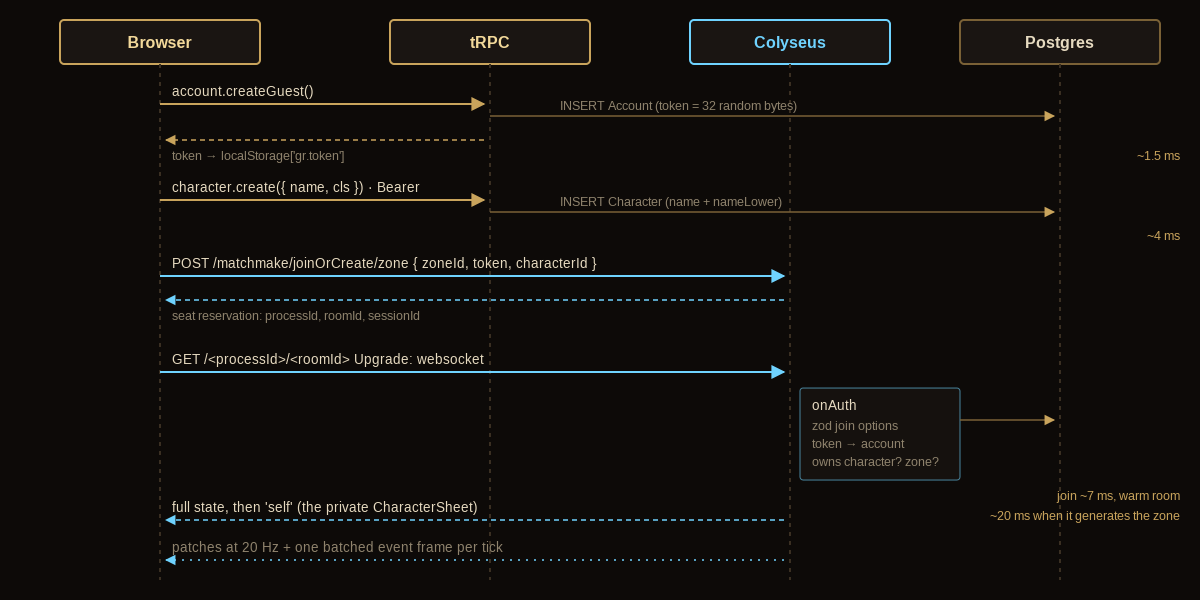
| Step (median of six, local) | Time |
|---|---|
| Create guest | ~1.5 ms |
| Create character | ~4 ms |
joinOrCreate, room exists |
~7 ms |
joinOrCreate, new room (map generation) |
~20 ms |
| First full state after join | < 1 ms |
The matchmaker is ordinary Express middleware, so it shares logging, error formatting and origin. The client needs no URL config:
/** One SDK client per page; same origin as the app (Colyseus shares the HTTP port). */
export function getColyseusClient(): Client {
  client ??= new Client(window.location.origin)
  return client
}
Accounts are a bearer token
No email, no cookie. "Enter the Reach" calls account.createGuest: 32 random bytes as hex, stored in localStorage['gr.token']. Claiming adds a username and a Bun.password hash for other devices.
/** Parse `Authorization: Bearer <token>`; null if absent/malformed. */
export function bearerToken(header: string | undefined): string | null {
  if (!header) return null
  const m = /^Bearer\s+([a-f0-9]{64})$/i.exec(header.trim())
  return m?.[1] ?? null
}
tRPC reads the header in createContext. Browsers can't set websocket headers, so Colyseus gets the token as a join option:
async onAuth(_client: ZoneClient, rawOptions: unknown, context: AuthContext): Promise<AuthData> {
  const parsed = joinOptionsSchema.safeParse(rawOptions)
  if (!parsed.success) throw new ServerError(400, 'bad join options')
  const opts = parsed.data
  let account: Account | null
  let character: LoadedCharacter | null
  try {
    account = await accountFromToken(opts.token)
    character = account ? await loadCharacter(opts.characterId, account.id) : null
  } catch (e) {
    // Never leak DB/zod internals to the client.
    log.error(`[zone] onAuth failed: ${formatError(e)}`)
    throw new ServerError(500, 'could not load character')
  }
  if (!account) throw new ServerError(401, 'invalid token')
  if (!character) throw new ServerError(403, 'character not found on this account')
  // …
}
Cost: SSR never knows the user. useToken() returns undefined through SSR and hydration so markup matches, then string | null:
export function useToken(): string | null | undefined {
  return useSyncExternalStore(subscribeToken, getToken, () => undefined)
}
Landing, blog and ladder are public anyway, and /play mounts client-side only.
A room is a world
Each ZoneRoom is one zone instance, capped at ROOM_MAX_CLIENTS = 40, with its own map, nav grid, monsters, loot and 20 Hz tick. Empty rooms dispose after 60 s. See Twenty ticks a second.
Parties, whispers, town portals and stash locks cross rooms. They live in hub.ts, a module-level registry:
export interface RoomHandle {
  roomId: string
  zoneId: string
  /** deliver an event to one character in this room; false if they aren't here */
  send<K extends ServerEventName>(characterId: string, type: K, payload: ServerEvents[K]): boolean
  broadcast<K extends ServerEventName>(type: K, payload: ServerEvents[K]): void
  setParty(characterId: string, partyId: string | null): void
  portalsChanged(): void
  // …
}
One process means the hub is a Map. A zone transfer is hub.setPending(characterId, …) in the old room and hub.peekPending in the new room's onAuth. A join to an unexpected zone with no pending entry is admitted and immediately sent a transfer back to the saved zone.
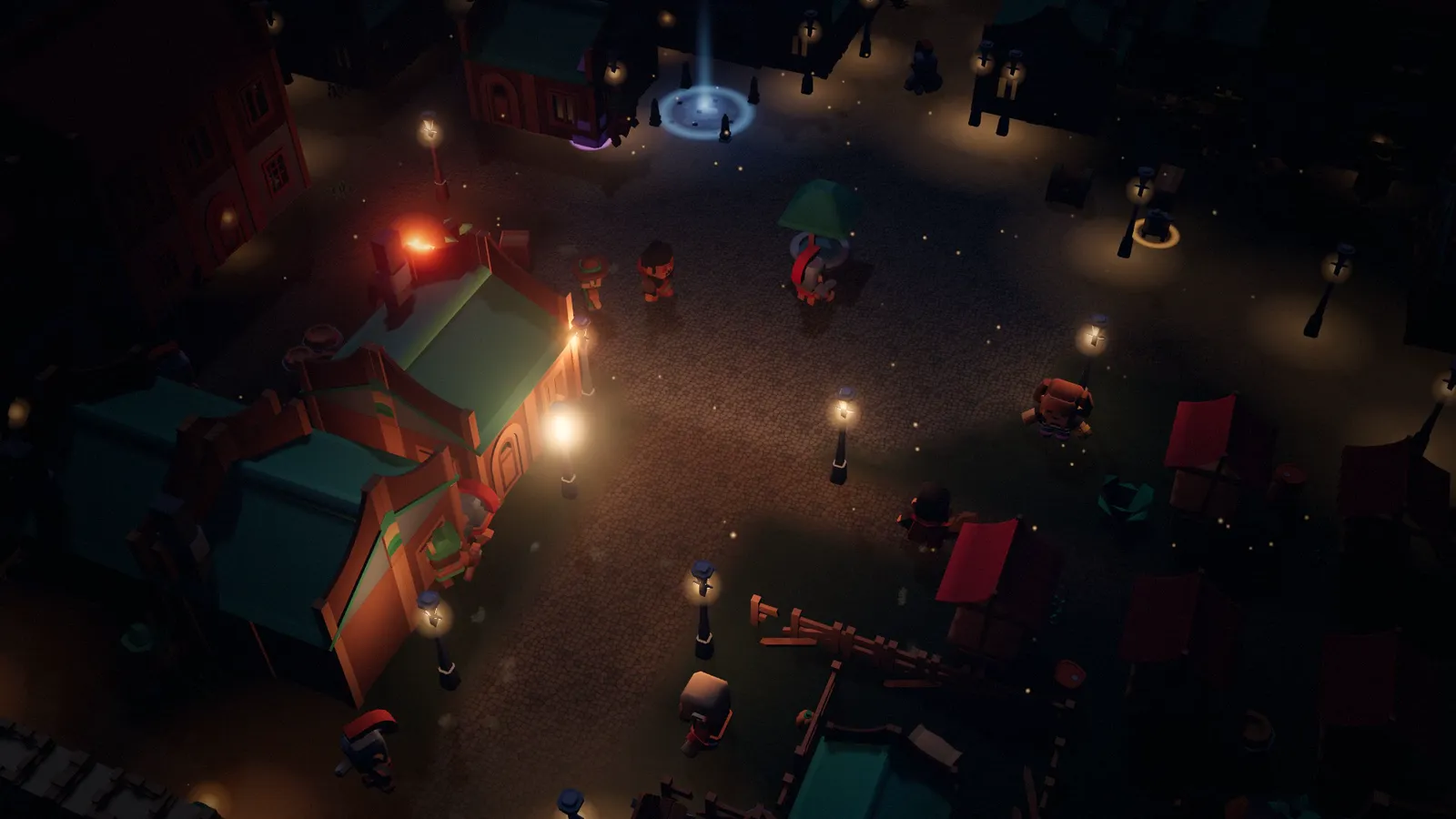
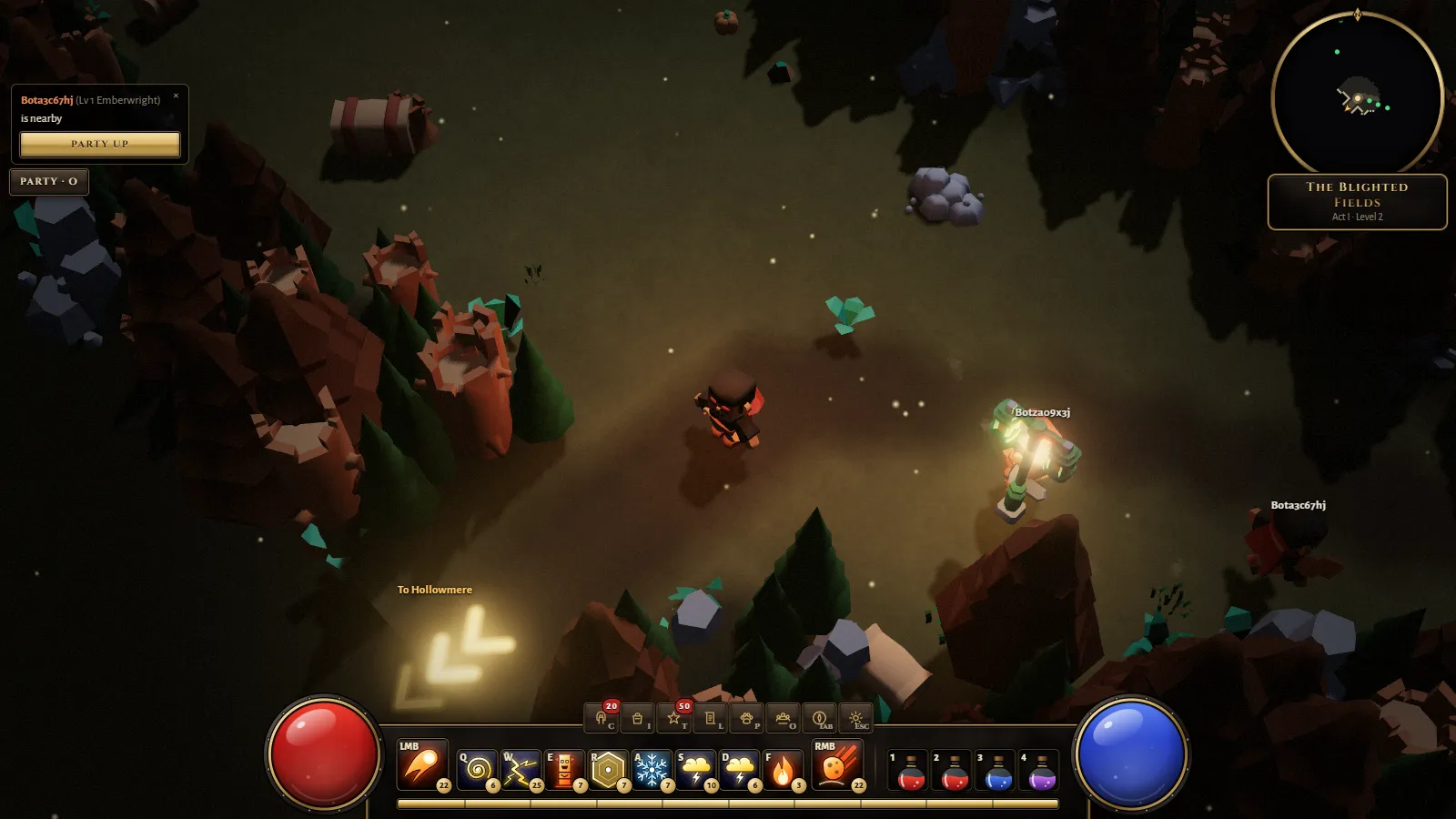
Cap check: 39 headless @colyseus/sdk bots (moving, fighting, drinking potions) plus a headless browser in one Blighted Fields instance, 75 seconds:
| Metric | Value |
|---|---|
| Tick average | 1.55 ms |
| Tick worst-window p95 | 4.78 ms |
| Worst single tick | 11.08 ms |
| Downstream per client | 8.8 KB/s, ~22 msg/s |
| Browser client | 60 fps, 240 draw calls |
zod at every edge
Anything from outside TypeScript's view is parsed:
- Env:
server/env.tsat import time, so a missingDATABASE_URLfails at boot - Client messages: one schema each in
shared/protocol.ts; failures are dropped - Join options:
joinOptionsSchemainonAuth - JSON columns:
parseCharacteron every load
const coord = z.number().finite().min(-10000).max(10000)
const id = z.string().min(1).max(64)

export const ClientMessageSchemas = {
  /** click-to-move destination (`walk`: a lightly pushed gamepad stick moves at walking pace) */
  move: z.object({ x: coord, y: coord, walk: z.boolean().optional() }),
  attackTarget: z.object({ id }),
  cast: z.object({ skill: id, x: coord, y: coord, targetId: id.optional() }),
  invMove: z.object({ from: SlotZ, to: SlotZ }),
  chat: z.object({ channel: z.enum(CHAT_CHANNELS), text: z.string().trim().min(1).max(200), to: z.string().max(32).optional() }),
  // …27 messages in all
} as const
Server → client events are typed, not validated. Batched events carry an index into SERVER_EVENT_NAMES, so a missing name would silently drop events; a conditional type makes that a compile error:
/** compile error here = a ServerEvents key is missing from SERVER_EVENT_NAMES (batched events would drop it) */
export const SERVER_EVENT_NAMES_COMPLETE: [Exclude<ServerEventName, (typeof SERVER_EVENT_NAMES)[number]>] extends [never] ? true : never = true
Saves, evictions and shutdown
A character saves on leave (disconnect, transfer, tab close), every 30 s while dirty, and on shutdown. SIGTERM → matchMaker.gracefullyShutdown() → every onLeave saves:
const stop = (signal: string) => {
  log.info(`${signal} received, saving players…`)
  void game.shutdown().finally(() => process.exit(0))
}
process.once('SIGINT', () => stop('SIGINT'))
process.once('SIGTERM', () => stop('SIGTERM'))
Double login (second tab, phone reconnecting) would mean two sessions saving one row. onAuth asks the hub, evicts the old session, waits for its save, then reloads from the database.
Migrations, not db push
db push --accept-data-loss drops columns without asking, so once real characters existed the project moved to migrations: a baseline 0_init marked applied, then named migrations, with prisma migrate deploy before each container starts. Six so far: 0_init, endgame, rift_runs, admin, companions, items_database.
The schema is 337 lines, 18 models. Core: Account, Character, Stash. Character state lives in zod-guarded Json columns, so new stats or item properties need no migration.
Shipping it
Production is Drydock: an arm64 container from a generated Dockerfile, a provisioned Postgres, Caddy passing websockets through.
name: gloamreach
kind: ssr          # ssr | static
runtime: bun        # bun | node
port: 4477
memory: 384        # MiB soft reservation (overrides size)
build: bun run build
start: bun run start
database: true      # provision Postgres + DATABASE_URL
prisma: true        # prisma generate on build, db push predeploy
predeploy: bun run db:deploy
dist/client holds the browser bundle, with Three.js and the game in chunks only engine pages load; dist/server holds the SSR entry. The container writes nothing to its filesystem. See shipping it.
The blog rides the same server
Posts in content/blog/ compile at build time through a Vite plugin into one lazy chunk each, highlighted at build time. The route's handle.head produces title, description, canonical and Open Graph tags, swapped into index.html:
// A route's own <head> (blog posts) replaces the default title + social block.
if (head) template = template.replace(/<!--head-->[\s\S]*?<!--\/head-->/, () => head).replace(/<!--social-->[\s\S]*?<!--\/social-->/, '')
Function-form replace, because the HTML contains code samples and a string replacement would expand $&. /blog/rss.xml calls renderRss from the same SSR bundle, so there's one copy of the post data per build.
What one process gives up
- One core runs every room. A 40-player room costs ~2 ms of a 50 ms tick, so a couple of dozen busy rooms fit before ticks collide. The admin live page shows per-room timings.
- Rooms can't move between processes. Scaling out means Colyseus presence and turning the hub from a
Mapinto a bus; cross-room state is already confined to one module. - A deploy disconnects everyone. Saves make it safe; the client reconnects into the saved zone after a few seconds.
In exchange: one command, one port, one log stream, one artifact, and stack traces that run from a React loader to a Prisma query.
Read next
- Twenty ticks a second: what happens inside a room, from command to patch
- Worlds from a seed: why the server never sends the map
- One day, forty agents: how the whole thing was built