From Kenney kits to a cohesive world
Nineteen free Kenney kits turned into one world through a typed manifest, desaturated skins, composites built from kit parts and a 15.75 MB build.
Contents
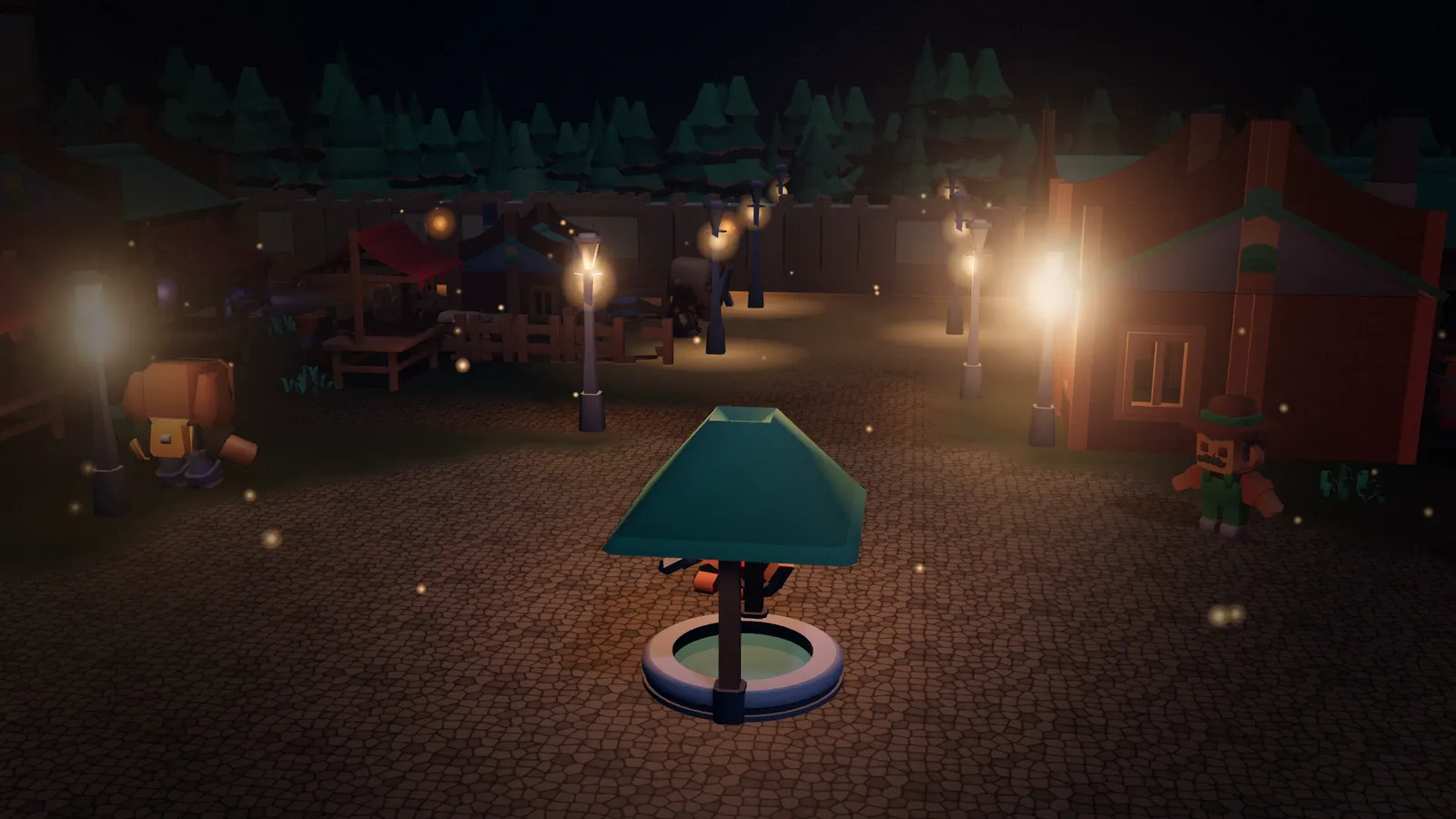
Every model, texture, sound and particle comes from Kenney's CC0 packs: 19 model kits made years apart for different genres, each with its palette baked into a small atlas. The pipeline makes a pirate-kit lighthouse, a holiday-kit cabin and a dungeon-kit demon look like one world, in a download a phone will tolerate.
The manifest is the only registry
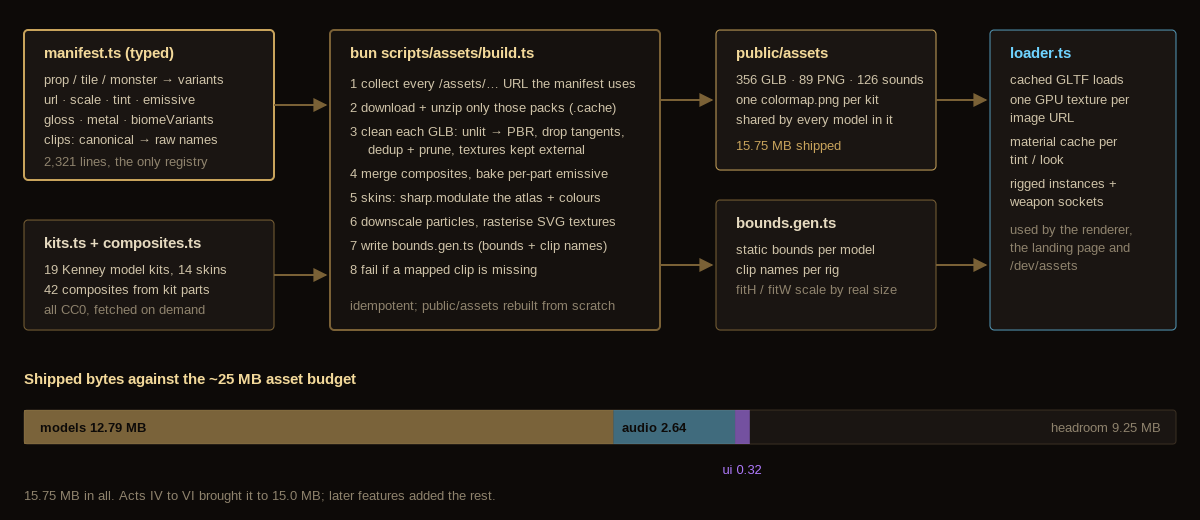
Nothing loads by path. src/game/assets/manifest.ts (2,321 lines) maps the shared vocabulary (props, tiles, monsters, bodies, weapons, sounds, UI sprites) to variants:
export interface ModelVariant {
  url: string
  scale: number | Vec3
  /** Added to y after scaling so the model sits on the ground (or the floor top sits at 0). */
  yOffset?: number
  /** Extra rotation about +Y (radians). */
  rotY?: number
  /** CSS hex multiplied into base colour. */
  tint?: string
  /** CSS hex emissive colour (glowing crystals, portals). */
  emissive?: string
  /** Relative pick weight among siblings (default 1). */
  weight?: number
  /** Molten surface (TileKind.Lava). … */
  lava?: true
  /** 0–1 smoothness (roughness = 1 − 0.9·gloss): wet rock, ice, polished mirror floors. */
  gloss?: number
  /** 0–1 metalness (mirror glass, dark reflective armour). */
  metal?: number
}- Weighted variants, picked by hashing position with the map seed, so 400 rocks aren't one rock and every client sees the same one.
- Per-biome overrides stretch one word across six acts. Generators place
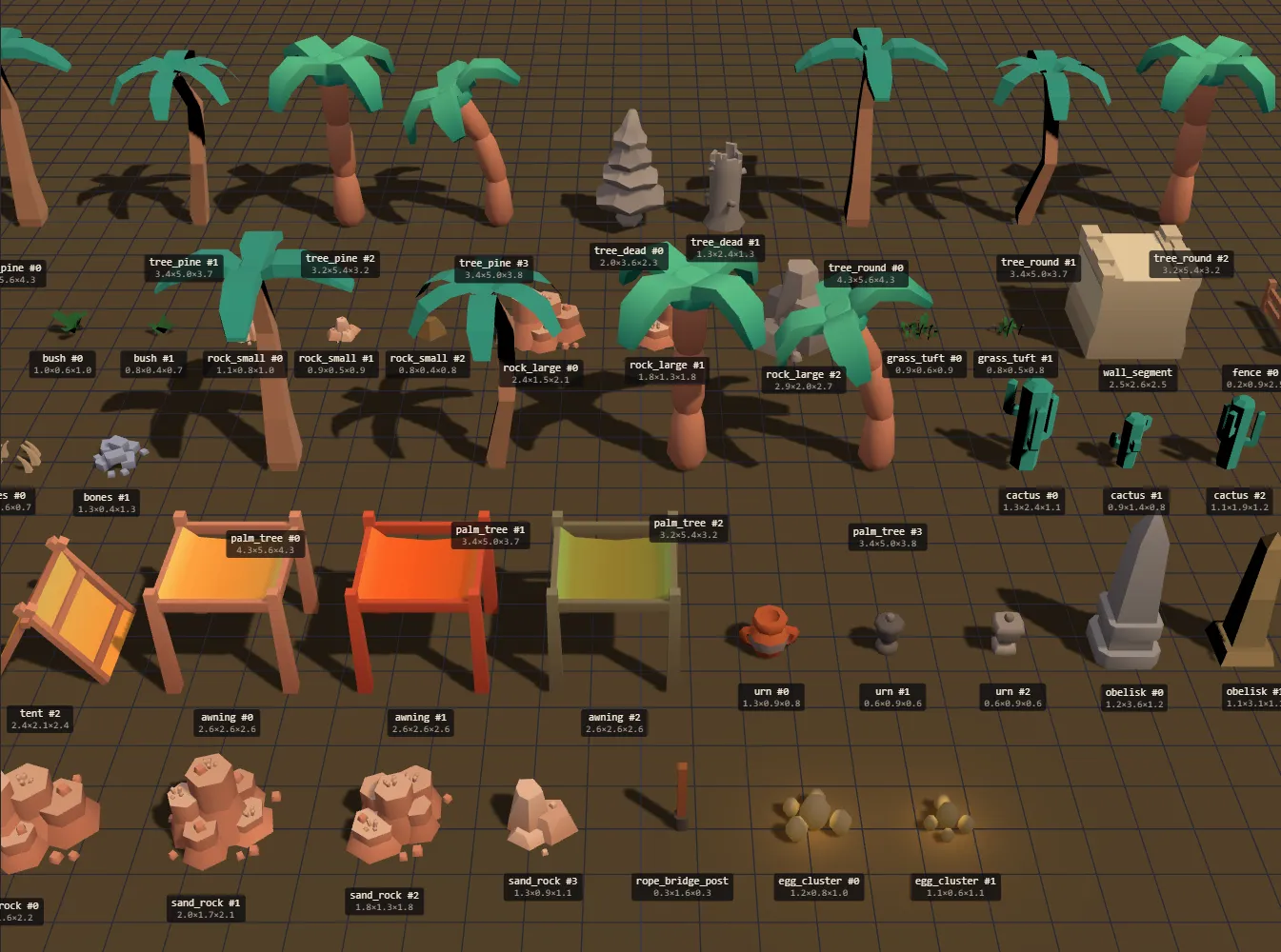
tree_pineeverywhere; the manifest makes it a pine, a palm or a charred stump:
tree_dead: { ...each(act2Outdoors, BLEACHED_DEAD), ...each(act3Outdoors, CHARRED) },
tree_round: { ...each(act2Outdoors, PALMS), ...each(act3Outdoors, CHARRED) },
tree_pine: { ...each(act2Outdoors, PALMS), ...each(act3Outdoors, CHARRED) },- Scale in world terms. Kits disagree about a metre, so
fitH(model, 4.6)andfitW(model, 2.1)read measured bounds and make models from any kit agree.
A build that ships only what is used
bun scripts/assets/build.ts collects every /assets/... URL the manifest references, maps each to its pack via kits.ts, downloads only those packs into an uncommitted cache, and rebuilds public/assets from scratch. Unused models disappear on the next build.
Each GLB is cleaned with glTF-Transform:
// Blocky Characters ship KHR_materials_unlit; we light everything with torches, so make them PBR.
for (const ext of root.listExtensionsUsed()) {
  if (ext.extensionName === KHRMaterialsUnlit.EXTENSION_NAME) ext.dispose()
}
// No normal maps anywhere in these kits, so tangents are dead weight.
const hasNormalMaps = root.listMaterials().some((m) => m.getNormalTexture() !== null)
if (!hasNormalMaps) {
  for (const mesh of root.listMeshes()) for (const prim of mesh.listPrimitives()) prim.setAttribute('TANGENT', null)
}
// …
await doc.transform(dedup(), prune({ keepLeaves: true }))- Atlases stay external: one
colormap.pngper kit, downloaded once, one shared GPU texture per URL at runtime. bounds.gen.tsrecords every model's bounds and every rig's clip names. Canonical clips (idle,walk,attack,cast,hit,die) map to raw names, and the build fails on a missing clip before anyone sees a T-pose.
| Shipped | |
|---|---|
| GLBs / PNGs / sounds | 356 / 89 / 126 |
| Models | 12.79 MB |
| Audio | 2.64 MB |
| UI | 0.32 MB |
| Total (budget ~25 MB) | 15.75 MB |
Everything under /assets gets year-long immutable caching.
Skins: desaturate, then tint
A tint multiplies, and multiplying only darkens: a red roof tinted sandstone turns muddy, a green tree tinted charred turns olive. So the build makes desaturated copies of whole kits, called skins, with every PNG and material colour run through sharp.modulate:
// Desaturated skins (see Kit.recolor): the manifest tints these into sandstone / basalt / bronze.
{ short: 'gyg', slug: 'graveyard-kit', kind: 'models', root: 'Models/GLB format', recolor: { saturation: 0.1, brightness: 1.1 } },
{ short: 'castleg', slug: 'castle-kit', kind: 'models', root: 'Models/GLB format', recolor: { saturation: 0.08, brightness: 1.15 } },
{ short: 'towng', slug: 'fantasy-town-kit', kind: 'models', root: 'Models/GLB format', recolor: { saturation: 0.1, brightness: 1.1 } },
// Act 4–6 skins: drowned wrecks, indigo void rock, and the dark-glass mirror knights (stalker rig).
{ short: 'pirateg', slug: 'pirate-kit', kind: 'models', root: 'Models/GLB format', recolor: { saturation: 0.1, brightness: 1.1 } },
{ short: 'blockyw', slug: 'blocky-characters', kind: 'models', root: 'Models/GLB format', recolor: { saturation: 0.05, brightness: 1.7 } },
On a near-grey base a tint gives a real hue: castleg + sand = Saltmarrow sandstone, + #6a6268 = Emberhold basalt; pirateg + sea-green = drowned wreck. 14 skins in all.
Composites: new models from kit parts
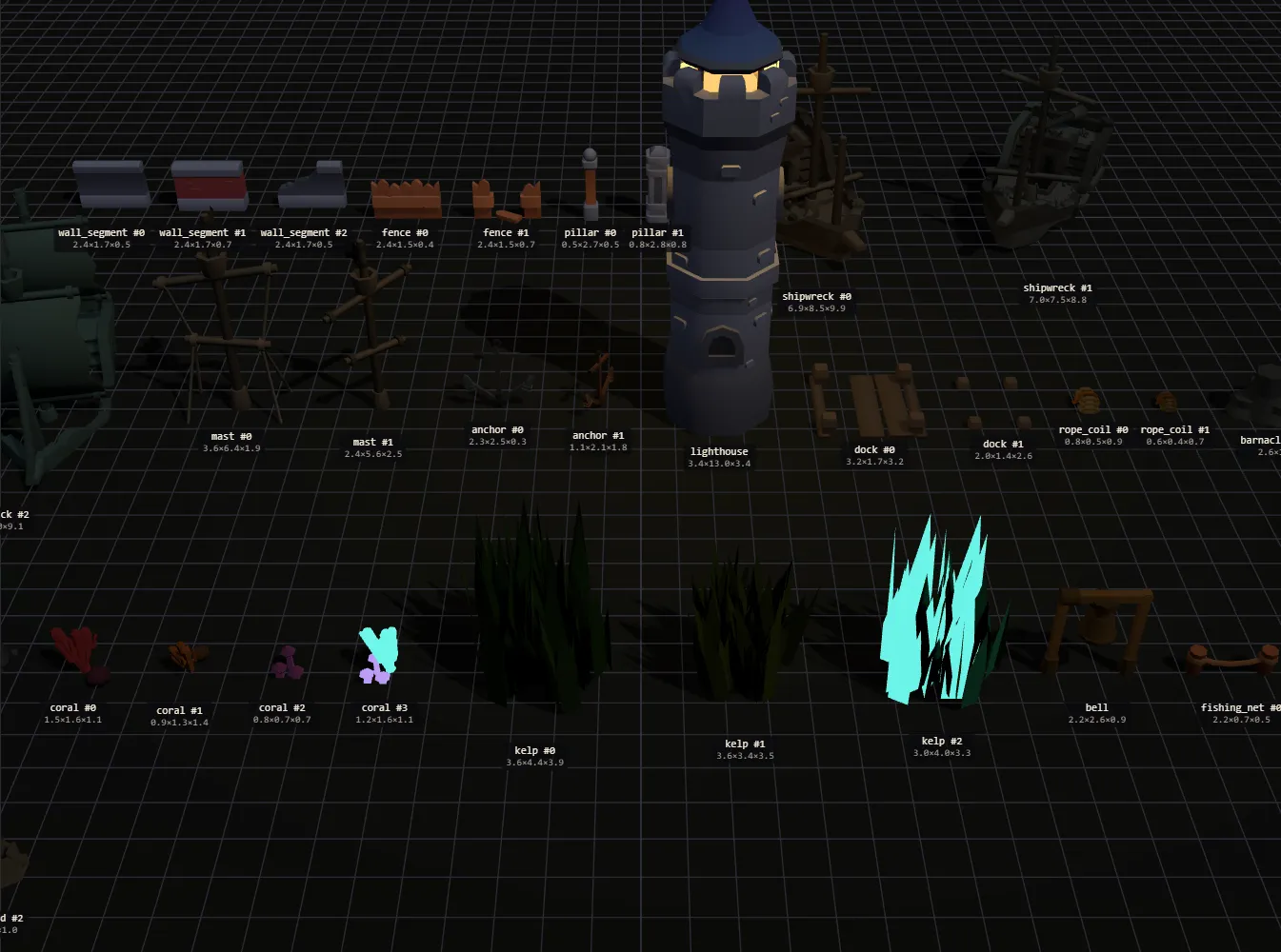
Kenney has no lighthouse, anchor, upside-down bell, snow cabin, void rift or final boss. composites.ts describes 42 models as lists of placed kit pieces, merged into one static GLB each:
lighthouse: [
  { src: 'pirate/tower-base', pos: [0, 0, 0] },
  { src: 'pirate/tower-middle-windows', pos: [0, 2, 0] },
  { src: 'pirate/tower-middle', pos: [0, 4, 0] },
  { src: 'pirate/tower-middle-windows', pos: [0, 6, 0], rotY: 1 },
  { src: 'pirate/tower-top', pos: [0, 8, 0] },
  // open lantern room: a blazing lamp between four posts, under the cap
  { src: 'pirate/cannon-ball', pos: [0, 9.75, 0], scale: 2.6, emissive: GLOW_GOLD },
  ...[0, 1, 2, 3].map((q): CompositePart => ({ src: 'town/pillar-wood', pos: [Math.cos((q + 0.5) * (Math.PI / 2)) * 1.05, 8.9, Math.sin((q + 0.5) * (Math.PI / 2)) * 1.05], scale: [1.4, 1.9, 1.4] })),
  { src: 'pirate/tower-roof', pos: [0, 10.75, 0], scale: [0.72, 0.6, 0.72] },
],- The lamp is a cannonball ×2.6, glowing.
- The Unmaker (7.5 tiles) is the graveyard ghost stretched 2.4× vertically, flattened cannonball eyes, a crown of seven violet rocks, four more in orbit. No clips; it hovers, like the Leviathan, glacier wyrm and gloam eye.
- Per-part
emissivebakes glow into one part, so only the lamp lights, not the tower. eulerwithorderlets bells hang upside down and masts lean.gloss/metal: the nature and space kits exportmetallicFactor: 1, and smooth metal with no env map renders black, so gloss forces metalness to 0 unlessmetalis set.
Characters and monsters from four rigs
| Class | Source |
|---|---|
| Warden | Mini Arena soldier |
| Stalker | Mini Forest archer |
| Emberwright | graveyard vampire, tinted warm |
| NPCs | Mini Characters |
Clip maps differ (BOW_CLIPS, CASTER_CLIPS); the renderer only asks for canonical names. 109 monster types come from a handful of rigs plus composites, varied by tint, scale and skin. An Act VI mirror knight is the matching player-class rig from a desaturated skin: violet tint and emissive, gloss 0.95, some metal.

/dev/assets lays out every character, monster, weapon, prop and tile set with measured bounds, filters by act and biome, plays any clip and toggles dusk lighting. It uses the game's loader, so it shows exactly what ships. Asset agents worked in a loop: edit manifest, reload, look.
Walls that don't flicker
Kenney wall panels each carry corner posts, so four panels around a house put two identical posts at every corner: z-fighting. The composite builder insets once:
/** Uniform shrink that tucks duplicated posts inside their twins (see walls / gableEnds). */
const INSET_K = 0.994

// e/w panels are shrunk a hair about their cell centre: every panel carries corner posts, so
// the s/n and e/w panels meeting at a corner would otherwise put two identical posts in the same
// place (coplanar faces → z-fighting). The inset post sits entirely inside the other one.
Player homes are built at runtime from boxes, and there the plaster panel and timber top plate shared a top face. Two centimetres:
/** How far a wall's timber top plate stands above its plaster panel (no coplanar tops). */
const CAP_PROUD = 0.02
// …
// the top plate stands CAP_PROUD above the plaster: equal tops z-fight (white/dark streaks)
along(d, 0.5, 0.22, 0.1 + CAP_PROUD, H - 0.1, 'timber')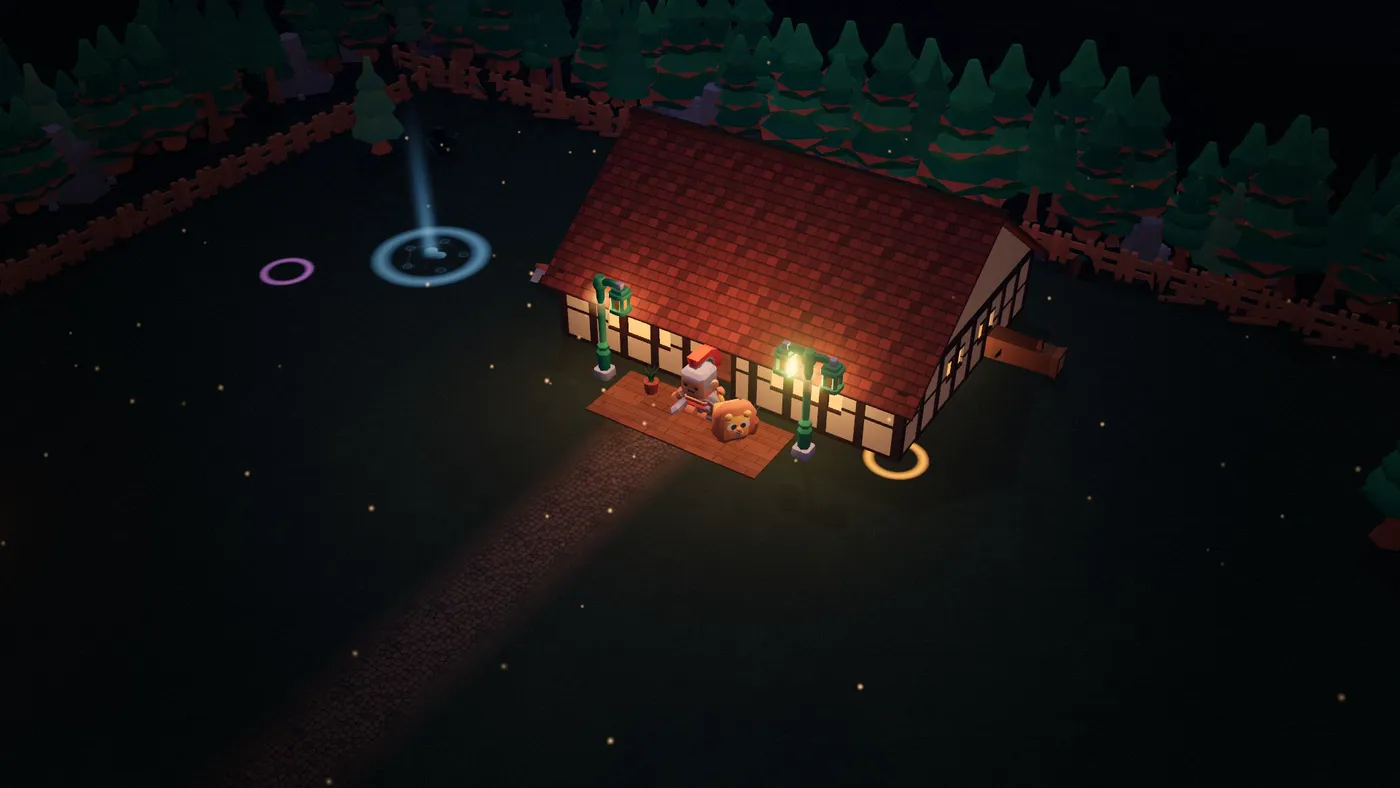
What made it cohesive
- One lighting model: everything PBR under per-biome presets, including Kenney's unlit characters
- Desaturated skins: colour chosen per biome, not inherited from a kit
- Normalised scale:
fitH/fitWagainst measured bounds - Heavy post: fog, bloom and a per-biome grade pull every frame to one palette (renderer)
No custom models: 19 free kits, a typed table and a build that refuses anything the table doesn't mention.
Read next
- Plain Three.js, pushed hard: how these models are instanced, lit and graded
- Six acts in an afternoon: the acts these assets were built for
- One day, forty agents: how the asset agents fit into the day