Nightmare, Hell and the Gloam Rifts
Three difficulties, monster stats refit by least squares, timed rifts on a three-part tier curve that survive restarts, a ladder, hardcore and Lantern Shards past 99.
Contents
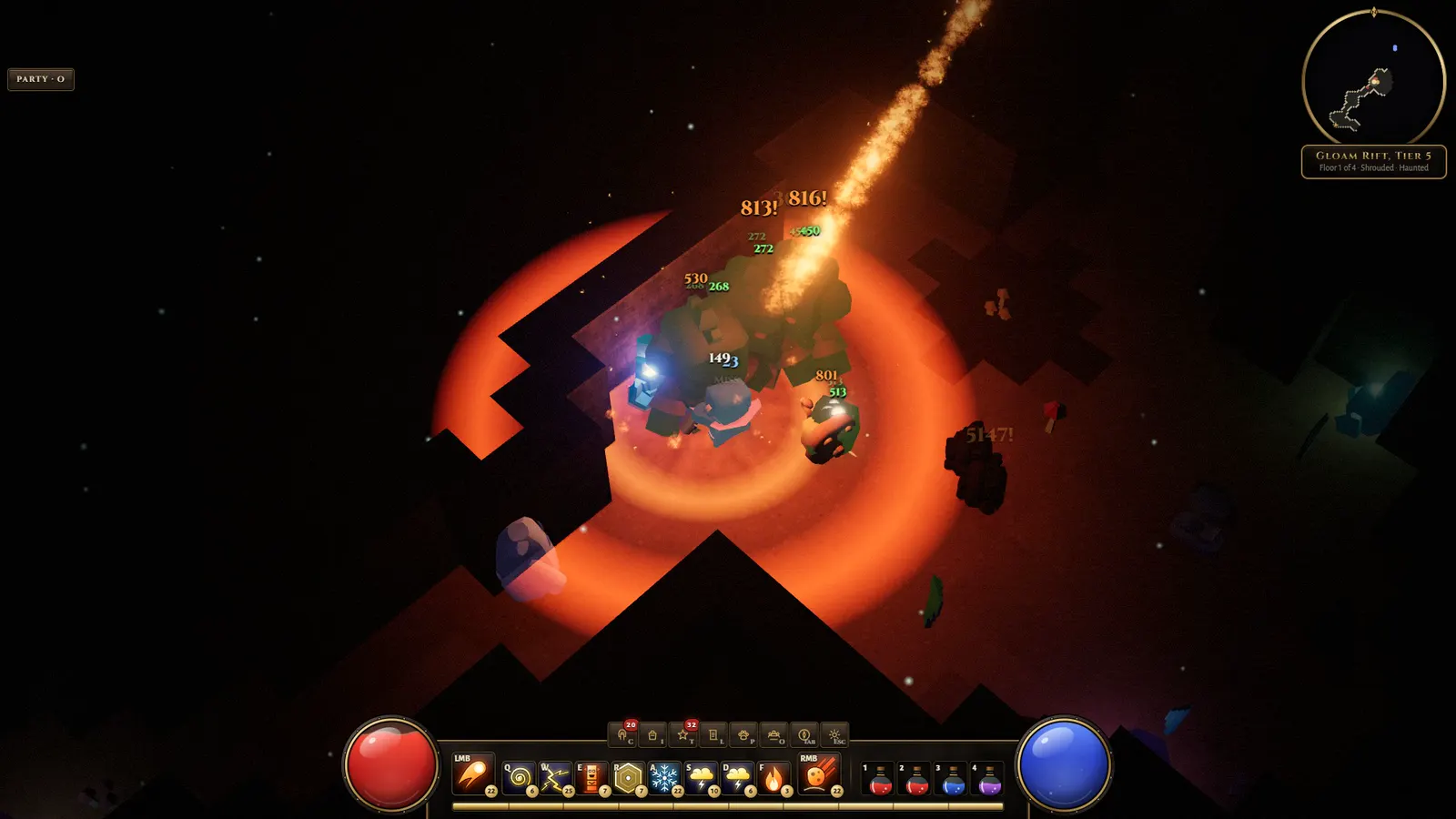
The story ends around level 75. After that: Nightmare and Hell, timed Gloam Rifts with no top tier, a ladder, hardcore and Lantern Shards past 99. The core problem is making monsters built for one level fight well at another, solved with a least-squares fit over the game's own monster data.
Three difficulties, like Diablo II
Killing the Unmaker unlocks the next difficulty for everyone in the fight. Quests, waypoints and zone are tracked per difficulty (the inactive two parked in the endgame JSON column). Rooms filter on zoneId and difficulty; cross-difficulty party invites are refused.
| Normal | Nightmare | Hell | |
|---|---|---|---|
| Monster level | the zone's level | 58 + 0.4 × zone level | 78 + 0.3 × zone level, capped at 99 |
| Monster life / damage | ×1 / ×1 | ×1.3 / ×1.15 | ×1.7 / ×1.35 |
| Monster resistances | +0 | +10 | +20 |
| Your resistances | +0 | −40 | −100 |
| Treasure quality | ×1 | ×1.25 | ×1.5 |
| Rune / gem chance per kill | 0.4% / 1.2% | 0.8% / 1.8% | 1.4% / 2.4% |
- Affine levels: a flat +30 would make Nightmare Act 1 trivial and Act 6 impossible. Nightmare Act 1 lands at ~59–64, Act 6 at ~88; Hell Act 1 at ~79–83.
- Over-level: past 99, Hell adds life ×1.04 and damage ×1.025 per level, up to 30 levels.
- −100% resist is straight from D2: resist gear matters again.
FINALE_BOSSESholds onlythe_unmaker. Other finales (the Ember Lord's Emberbane title) announce and grant titles but don't unlock.
Why level is not enough
Setting a monster's level and letting monsterStats scale it fails: Act 4–6 monsters at level 35 killed level-60 heroes at tier 5. Later acts ship bigger base stats because the level curve alone can't keep up with gear. An Act 6 base scaled down to 35 is still a wall; an Act 1 zombie at 70 is paper.
Fitting an era curve
shared/endgame/levelNorm.ts fits log(base) = a + b × nativeLevel by ordinary least squares, per stat, over every story monster (native level = the level of the zones it spawns in):
const fit = (s: Stat): Fit => {
  let n = 0
  let sx = 0
  let sy = 0
  let sxx = 0
  let sxy = 0
  for (const p of pts) {
    const v = baseOf(p.m, s)
    if (v <= 0) continue
    const y = Math.log(v)
    n++
    sx += p.x
    sy += y
    sxx += p.x * p.x
    sxy += p.x * y
  }
  const den = n * sxx - sx * sx
  const b = n < 2 || den === 0 ? 0 : Math.max(0, (n * sxy - sx * sy) / den)
  return { a: n > 0 ? (sy - b * sx) / n : 0, b }
}| Stat | Slope per level | Act 1 zombie at level 60 |
|---|---|---|
| Life | 0.0128 | ×2.05 |
| Damage | 0.0065 | ×1.44 |
| Defense | 0.0280 | ×4.82 |
| Attack rating | 0.0121 | ×1.98 |
Normals are multiplied by exp(b × (level − nativeLevel)): a tank stays tanky, a swarm stays frail. Defense moves most because it grew fastest across the acts.
- Bosses were hand-tuned per act, so they get their own fitted line and every boss sits on it: every rift guardian at a tier is the same size of fight.
- Above 70, monsters fight at stat level
70 + 0.25 × (level − 70): a level-99 monster has level-77 stats, with the real level for XP, ilvl and hit chance. Player power flattens; this keeps monsters from running away. - One function,
scaleMonster, serves both the server hook and the tests.
Gloam Rifts
A Rift Stone by every waypoint opens tier 1 up to your best in-time clear plus one. Tier 5+ costs a Rift Key (Nightmare/Hell bosses, rift guardians). Parties enter one instance from any town.
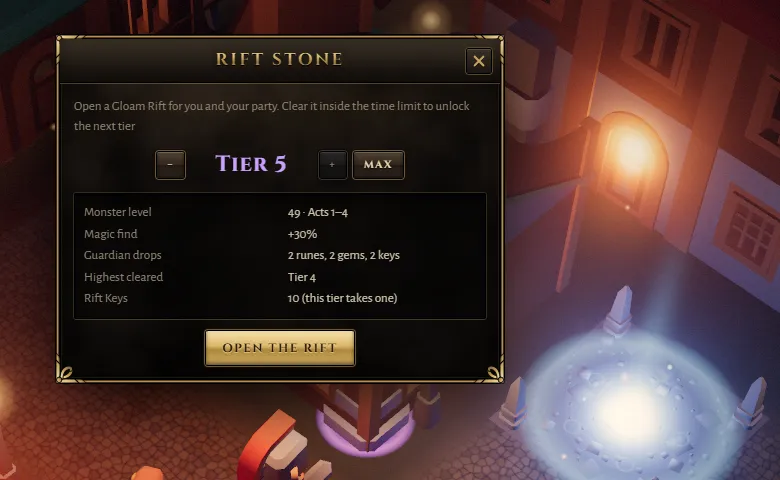
- 3–5 generated floors, 150 s each plus 90 s for the guardian (any non-finale boss)
- 2–3 of ten modifiers: Volatile, Haunted, Frenzied (×1.3 move, ×1.25 attack speed), Shrouded (−5 light), Bountiful (+100% MF and gold, the only kind one), Ironclad (+60% life), Teeming (×1.5 density), Venomous (35% as poison), Empowered (2× champions and uniques), Vampiric (12% leech)
export function riftPower(tier: number): MonsterScale {
  const t = Math.max(1, tier)
  if (t <= RIFT_LEVEL_KNEE_TIER) return NO_SCALE
  const mid = Math.min(t, RIFT_RAMP.highTier) - RIFT_LEVEL_KNEE_TIER
  const high = Math.max(0, t - RIFT_RAMP.highTier)
  return {
    life: Math.pow(RIFT_RAMP.life, mid) * Math.pow(RIFT_RAMP.lifeHigh, high),
    dmg: Math.pow(RIFT_RAMP.dmg, mid) * Math.pow(RIFT_RAMP.dmgHigh, high),
    def: 1 + high * 0.02,
    res: Math.min(25, high),
  }
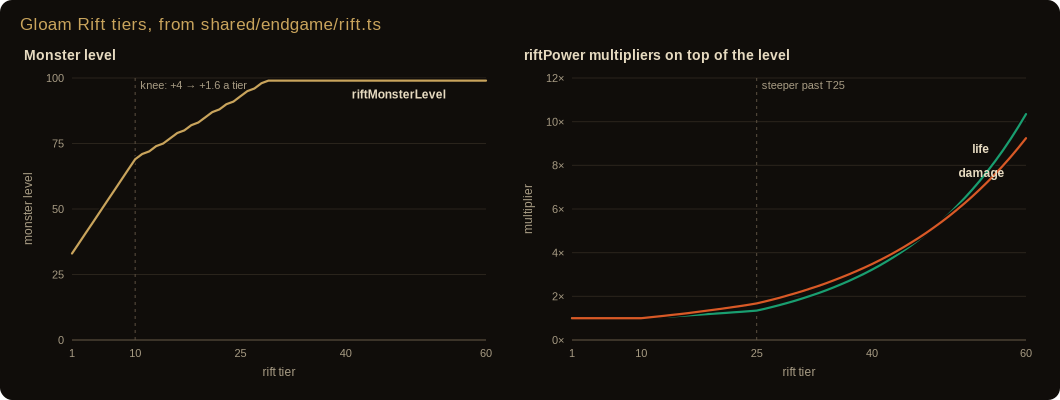
}| Tiers | Level | Extra scaling |
|---|---|---|
| 1–10 | 33 + 4 per tier (T10 = 69, an Act 6 finisher) | none |
| 10–25 | +1.6 per tier | life ×1.02, damage ×1.035 per tier |
| 25+ | cap 99 at T29 | life ×1.06, damage ×1.05, plus defense and resists |
No top tier: T40 is 3.2× life and 3.5× damage; T55 is 7.7× and 7.2×.
The pool opens by tier: T1–3 draw Acts 1–3, each three tiers add an act, all six by T10, so a tier-5 rift can't roll Act 6 monsters. Guardians hit half as hard as in the story: a gate, not a finale.
The tier table
Hero at the tier's target level in act-appropriate rares; cells are Warden / Stalker / Emberwright:
| Tier (hero) | Mlvl | Average kill | Guardian | Kills you |
|---|---|---|---|---|
| T1 (40) | 33 | 1.0 / 1.3 / 1.2 s | 20 / 25 / 26 s | 46 / 20 / 18 s |
| T5 (55) | 49 | 1.5 / 1.7 / 2.4 s | 35 / 37 / 63 s | 36 / 12 / 9 s |
| T10 (72) | 69 | 4.3 / 4.2 / 7.1 s | 122 / 118 / 214 s | 32 / 15 / 9 s |
| T15 (80) | 77 | 5.5 / 5.1 / 9.2 s | 159 / 151 / 283 s | 28 / 13 / 8 s |
| T25 (90) | 93 | 9.0 / 8.0 / 14.4 s | 276 / 238 / 456 s | 19 / 9 / 6 s |
| T40 (99) | 99 | 26 / 21 / 42 s | 811 / 642 / 1270 s | 11 / 5 / 4 s |
| T55 (99) | 99 | 71 / 55 / 111 s | 1556 / 1556 / 2000 s | 6 / 3 / 2 s |
- Bands are asserted, so tier 5 can't quietly turn lethal again.
- Past 70 the test heroes wear extrapolated rares; runewords and uniques make T25+ softer.
- The pure-fire Emberwright is slowest everywhere (fire-resistant Act 3 demons). T55 is meant to be a wall.
- Difficulties: a level-75 Warden kills Nightmare Act 1 in 1.9 s (vs 2.7 s in Normal Acts 5–6) and takes ~25% more damage. At level 90 in Hell Act 1: 5.9 s per kill, dies to one monster in 13 s.
A clear pays everyone inside: XP worth 60 + 6×tier normal kills, runes, gems, a rare, gold, keys, uniques from T10 (two from T25). In time: next tier unlocked, ladder row written.
Rift runs survive a restart
Every deploy (and every bun --watch edit) restarts the one process. The in-memory registry is mirrored to a RiftRun table (key, tier, seed, modifiers, owner, party, members, deepest floor, clock, who's been paid), with per-key promise chains so a save never lands after its delete:
function write(key: string, op: () => Promise<void>): void {
  const next = (chains.get(key) ?? Promise.resolve()).then(op).catch((e: unknown) => log.error(`[rift] ${key} write failed: ${formatError(e)}`))
  chains.set(key, next)
  void next.finally(() => {
    if (chains.get(key) === next) chains.delete(key)
  })
}- Boot waits on
riftsReady(). Floors aren't stored:rift_<act>_<tier>_<seed>_<floor>regenerates the same map. - Members rejoin their saved floor; the clock keeps running.
- Rules changed since the run started (stored modifiers ≠ what the seed gives now): the run is dropped, not resumed as a different rift.
rewardedis persisted, so no double payouts.- Stranded heroes wake in town: "The rift you were in has closed. You wake in town".
The ladder and hardcore
/ladder has four boards (level/XP, best in-time tier solo and party, fastest kill of every story boss per difficulty), each with softcore/hardcore and class filters. The character sheet shows rank.

Hardcore is a skull toggle with the warning beside it. Death is permanent: the hero becomes a gray-named ghost that can chat and walk town but not fight, with a ladder tombstone. Living hardcore heroes get red names and a separate account stash.

Past level 99: Lantern Shards
Level 99 is ~1.96 billion XP. Past it, XP banks into shards (one per twentieth of the 98→99 level) that buy account-wide ranks, Paragon-style. Rank r costs 1 + ⌊r/5⌋.
| Lantern | Per rank | Max |
|---|---|---|
| Magic find | +1% | 50 |
| Gold find | +1% | 50 |
| Life | +5 | 40 |
| Movement speed | +1% | 10 |
| All resistances | +1% | 15 |
| Experience | +1% | 10 |
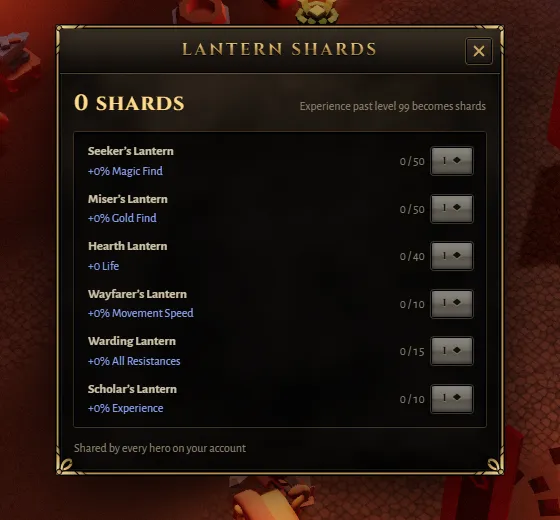
Small on purpose: +50% MF already hits diminishing returns.
Measuring what a player feels
The tier curve is three lines of constants; it only means something next to "tier 5 at level 55: 1.5–2.4 s per kill, 9–36 s to die to one monster". Every formula ships with a test that prints what a player experiences and asserts a band, as in combat math.