Seeing everything without breaking anything: the admin console
Live players and rooms, every hero rendered with the game's own panels, a self-hosted history, and audited levers that change a live hero through the room that owns it.
Contents
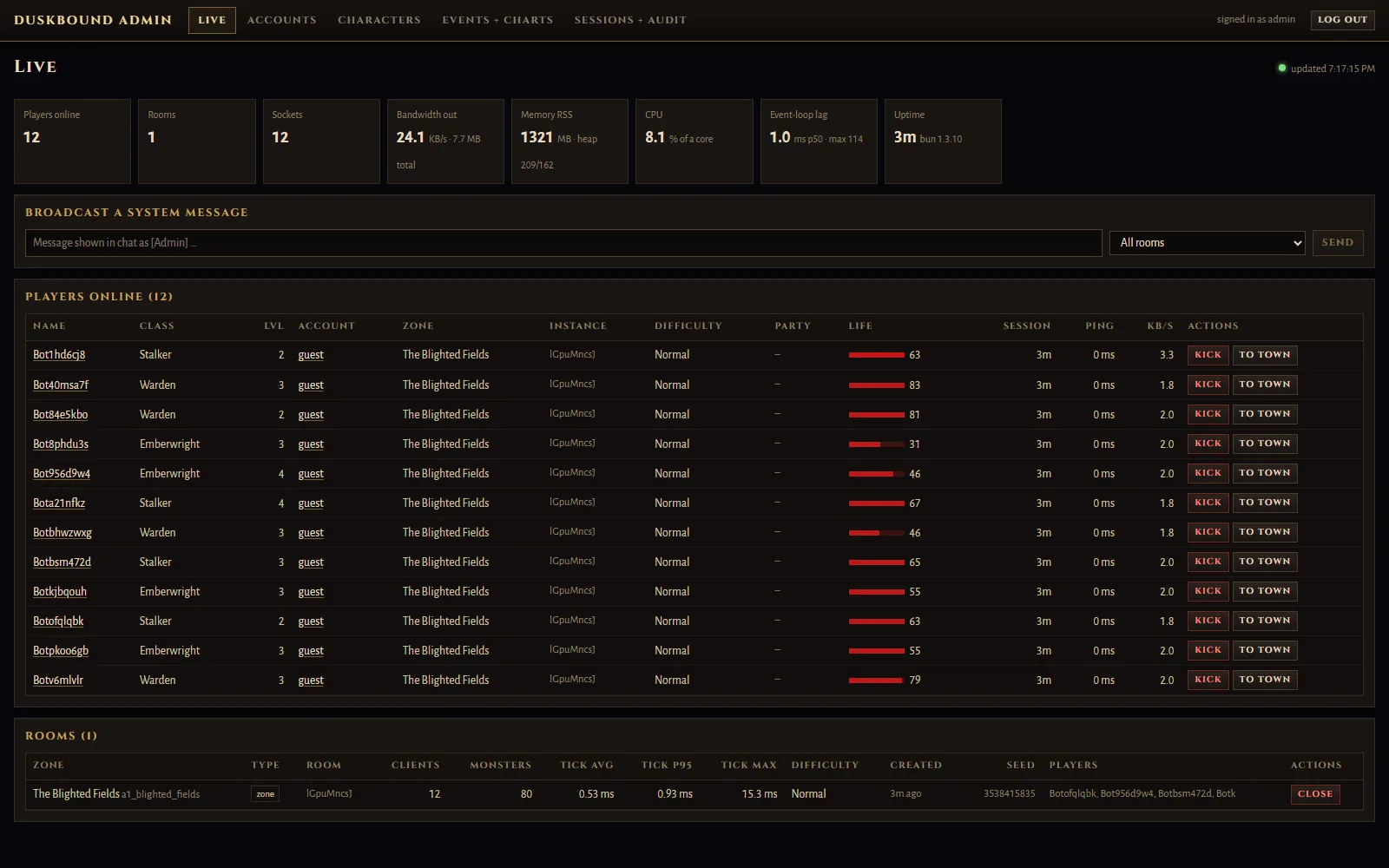
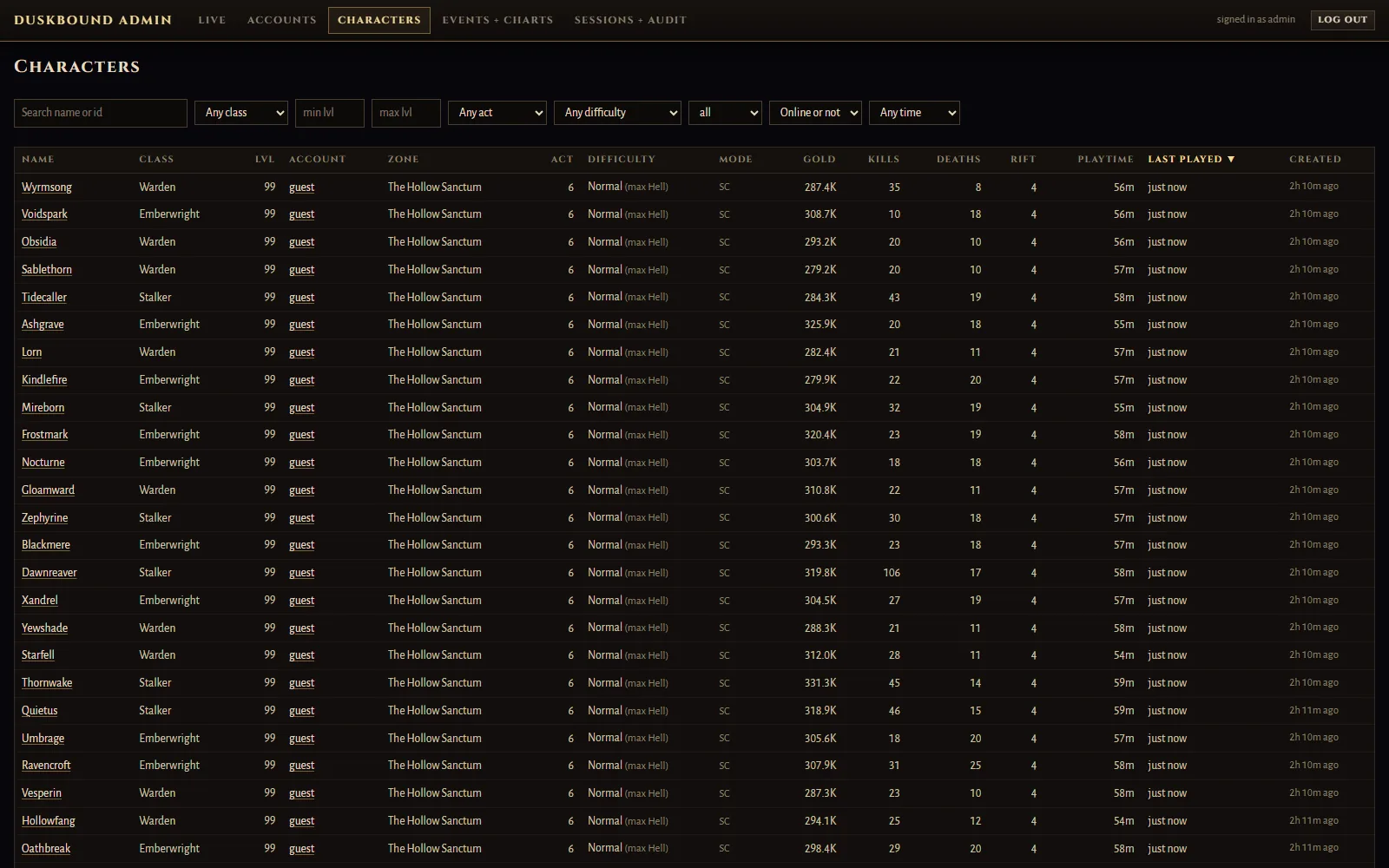
One place to see who is online, everyone who has played, and every hero down to its last item. The first /admin landed by the 16:58 checkpoint; it's ~5,400 lines across server/admin, server/game/admin, server/routers/admin and src/admin, four tables and one migration.
The brief
One Opus 5.5 agent (ADMIN), five pages and one constraint:
- Live: who's online, in which room, room and process health
- Accounts and Characters: searchable, sortable, with detail pages
- History: charts plus a feed of notable events
- Log: play sessions and an audit trail
- Levers: kick, broadcast, mute, ban, give gold or items, send to town, grant a pet, undo a hardcore death, close a room
The constraint: an admin action on an online hero goes through the room that owns that hero.
The rule: never write under a live sim
While a hero is online, its SimPlayer is the truth, and each room save (every 30 s when dirty, on transfer, on leave) rewrites the whole Character row. A direct gold = gold + 1000 would be silently overwritten by the next save.
Each room registers an AdminRoomOps with the hub as RoomHandle.admin:
export interface AdminRoomOps {
  info(): AdminRoomInfo
  players(): AdminLivePlayer[]
  /** the live sheet (inventory, stats, derived) of a character in this room */
  sheet(characterId: string): CharacterSheet | null
  kick(characterId: string, reason: string, code: number): boolean
  /** null on success, else why not */
  giveGold(characterId: string, amount: number): string | null
  /** into the bag, or at their feet when the bag is full; returns where it went, or an error */
  giveItem(
    characterId: string,
    item: ItemInstance
  ): { ok: true; where: 'bag' | 'ground' } | { ok: false; error: string }
  toTown(characterId: string): string | null
  /** kick everyone and dispose the room */
  close(reason: string): void
}
Online: through the room. Offline: onto the hero's save chain, the same promise queue rooms use, so it can't race a logout's save still in flight.
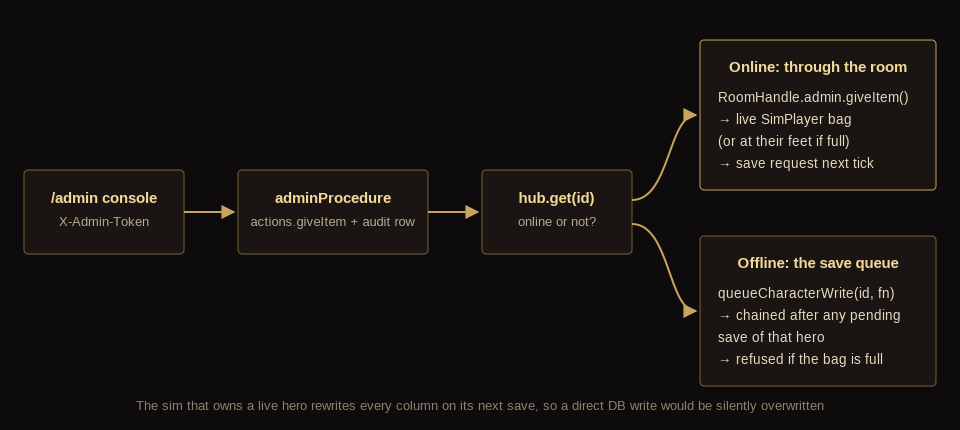
Both branches, including a login between the check and the write:
giveItem: adminProcedure
  .input(z.object({ characterId: Id, spec: GiveItemSpecZ }))
  .mutation(async ({ ctx, input }) => {
    const c = await characterOrThrow(input.characterId)
    const item = buildGiftItem(freshRng(), input.spec)
    const ops = liveOps(c.id)
    let where: 'bag' | 'ground'
    let via: 'room' | 'db'
    if (ops) {
      const r = ops.giveItem(c.id, item)
      if (!r.ok) throw new TRPCError({ code: 'CONFLICT', message: r.error })
      where = r.where
      via = 'room'
    } else {
      const loaded = await loadCharacter(c.id, c.accountId)
      if (!loaded) throw new TRPCError({ code: 'NOT_FOUND' })
      const next = pickupItem(loaded.save.inventory, item)
      if (!next) throw new TRPCError({ code: 'CONFLICT', message: `${c.name}'s bag is full` })
      if (hub.get(c.id))
        throw new TRPCError({ code: 'CONFLICT', message: `${c.name} just logged in; try again` })
      const { inventory } = characterWriteData({ save: { ...loaded.save, inventory: next } })
      await queueCharacterWrite(c.id, Promise.resolve(), () =>
        prisma.character.update({ where: { id: c.id }, data: { inventory } })
      )
      where = 'bag'
      via = 'db'
    }
await writeAudit(ctx.actor, 'give_item', { id: c.id, name: c.name }, { /* item, rarity, ilvl, uid, where, via */ })| Action | Online | Offline |
|---|---|---|
| kick | socket closed with code 4003 and a reason; the client shows it and doesn't auto-reconnect | n/a |
| broadcast | an [Admin] … system line in chat, to every room or one |
n/a |
| mute | hub flag on every online hero of the account | Account.mutedUntil |
| ban | every online hero closed with 4004 | Account.bannedAt, refused in tRPC, login and onAuth |
| give gold / item | through RoomHandle.admin, then a save request |
on the hero's save queue |
| send to town | the room's own waypoint transfer (or respawn if dead) | zoneId = act town, x = y = -1 |
| undo hardcore death | kick the ghost first, then clear dead |
clear dead |
| close room | room.disconnect(): everyone saved, clients rejoin a fresh instance |
n/a |
Bans cover every entrance: accountProcedure, account.login, and both rooms' onAuth. /play shows the reason instead of a spinner.
Reusing the game's panels
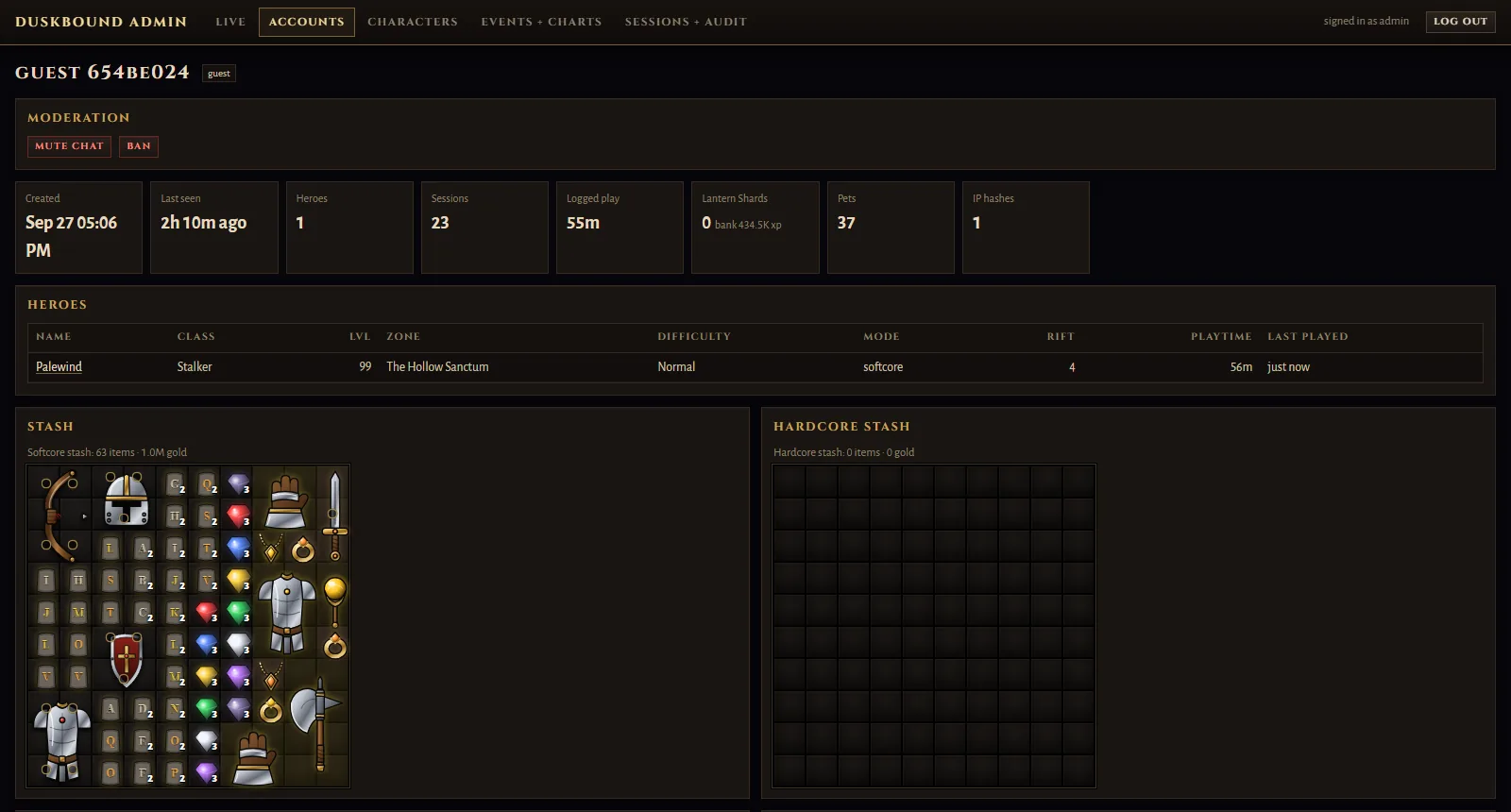
The character page has no new UI: it renders the game's StatsSheet, InventoryPanel, SkillTree and ItemGrid with real tooltips. They were presentational from the first hour (a ui.md rule), so the admin agent just fed them props.
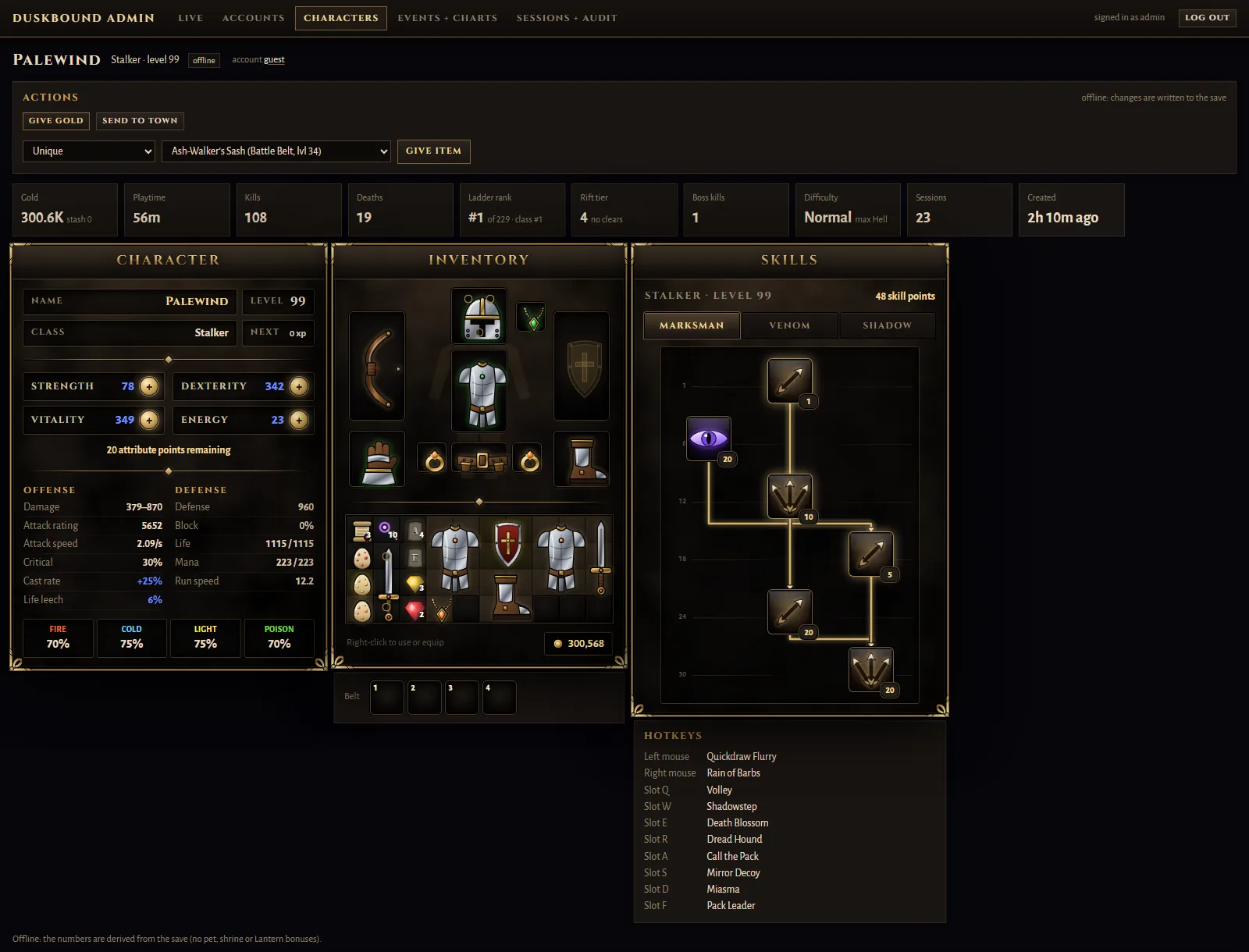
- Online: the sheet comes from
AdminRoomOps.sheet, refreshed every 5 s, with buffs, pet bonus and current life - Offline: derived from the save, labelled "Offline: the numbers are derived from the save (no pet, shrine or Lantern bonuses)"
- Below: quests and waypoints for all three difficulties, pet, house, event timeline, every session
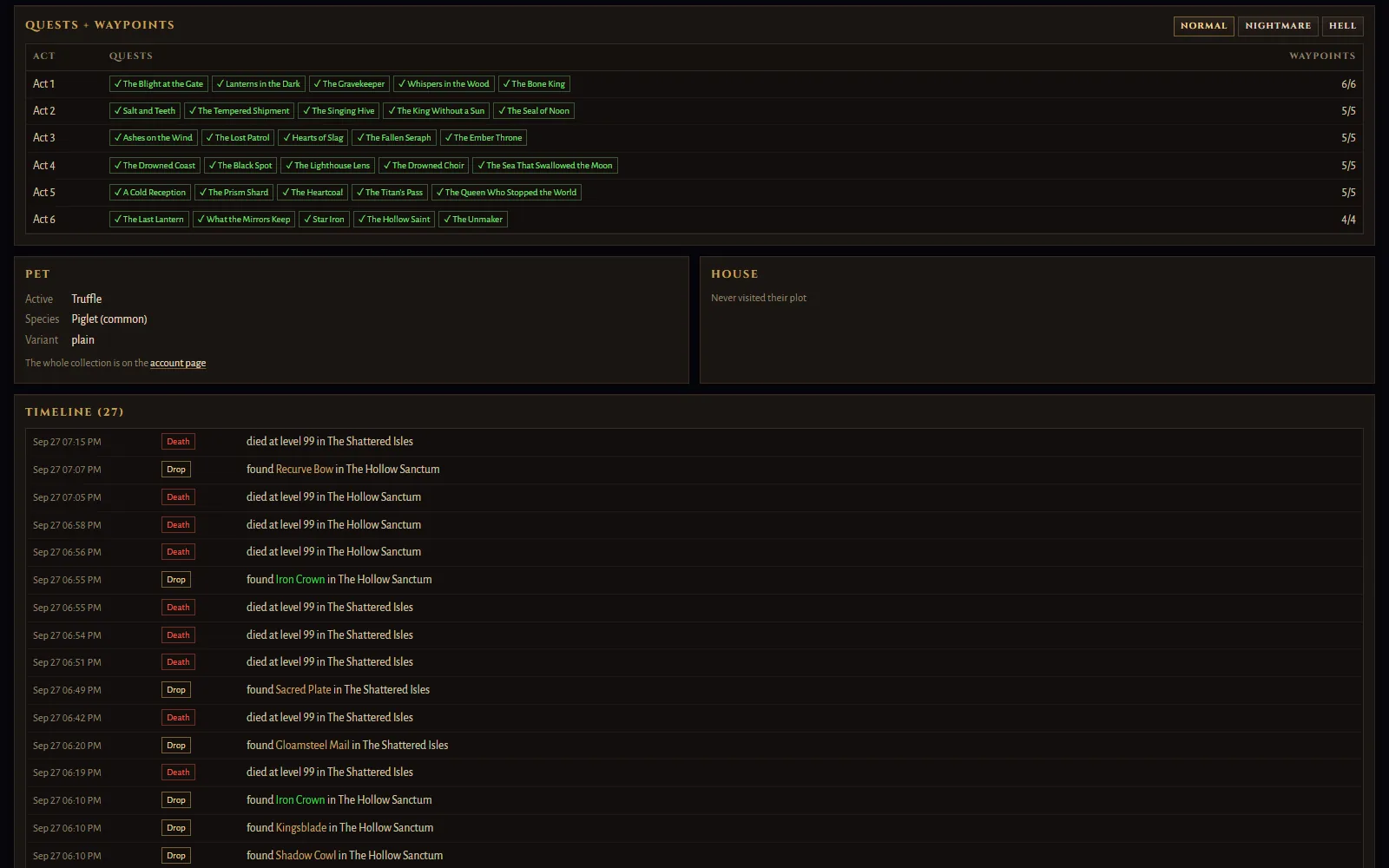
Palewind's feed, a column of "died at level 99 in the Hollow Sanctum", is the best record of the forty-hero stress test.
Sorting heroes by an act that isn't a column
Progress lives in a JSON array of waypoint ids like a4_town. Rather than add a column and a second source of truth, it's computed in SQL, with sorts whitelisted:
/** highest act whose town the hero has a waypoint to (1–6) */
const ACT_SQL = Prisma.sql`COALESCE((SELECT max(substring(w FROM '^a([0-9])_')::int)
  FROM jsonb_array_elements_text(CASE WHEN jsonb_typeof(c.waypoints) = 'array'
    THEN c.waypoints ELSE '[]'::jsonb END) AS w), 1)`

const CHARACTER_SORTS: Record<(typeof CHARACTER_SORT_KEYS)[number], Prisma.Sql> = {
  name: Prisma.sql`c."nameLower"`,
  level: Prisma.sql`c.level`,
  act: Prisma.sql`act`,
  // … gold, playtime, deaths, kills, rift, lastPlayed, created
}
A zod enum picks a prebuilt Prisma.sql fragment, so input never reaches the SQL text. Server-side pagination, 50 per page with count(*) OVER (); the dev database had 230 heroes by evening.
History without a metrics stack
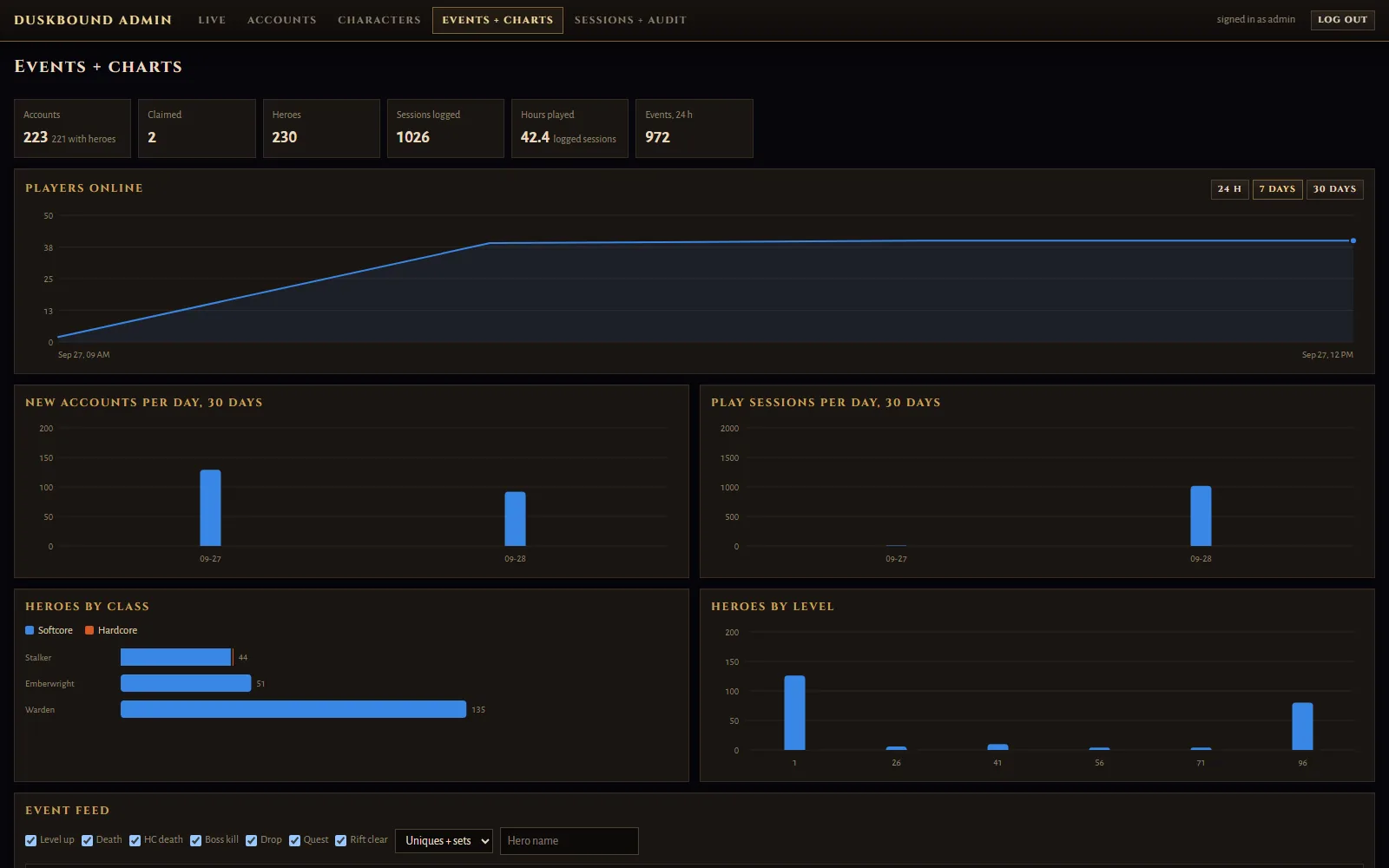
No Prometheus, Grafana or third-party analytics. Three tables the game writes itself:
PlaySession: a pureSessionTrackeron the hub's presence hooks. Re-register within the 30 s grace (transfer, trip home) extends the session and appends the zone; crash-orphaned rows close atlastSeenAton boot.GameEvent: level-ups, deaths, hardcore deaths, boss kills, unique and set drops, quests.recordGameEvent()only pushes to memory; a recordercreateManys every 5 s, re-queues on failure, caps at 5,000. No I/O in the tick.MetricSample: one row a minute (online, rooms, RSS, heap, tick p95), kept 30 days.
Chart rules: one axis, 2 px line with a 10% wash, columns ≤ 24 px with rounded ends, hairline grid, a tooltip on every mark, a legend only for two series, colours checked for colour-vision-deficiency separation.
Privacy, per decisions.md: IPs stored only as sha256(salt | ip) truncated to 16 hex characters (enough to spot a returning player on a new guest account, useless if leaked); user agents trimmed to 160 characters. The Live page samples event-loop lag from a 250 ms timer's drift, CPU from process.cpuUsage(), and per-socket bytes and ping from the transport's 5 s pings.
Two ways in
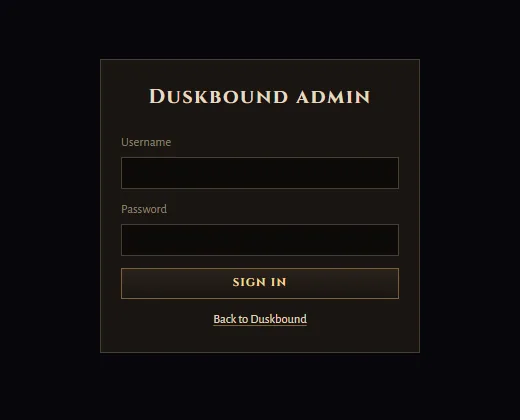
ADMIN_USERNAMES matches claimed game accounts, but a fresh database, restored backup or new environment has nobody who qualifies. So an ADMIN-LOGIN agent added a standalone login, in by the 17:38 checkpoint:
/** Constant-time: both sides are hashed to 32 bytes first, so lengths never leak. Empty config = disabled. */
export function checkAdminLogin(username: string, password: string, creds = ENV_CREDS): boolean {
  if (!creds.login || !creds.password) return false
  const userOk = timingSafeEqual(sha256(username.trim().toLowerCase()), sha256(creds.login.toLowerCase()))
  const passOk = timingSafeEqual(sha256(password), sha256(creds.password))
  return userOk && passOk
}

function signingKey(creds: AdminCredentials): Buffer {
  return sha256(`duskbound-admin-key:${creds.login.toLowerCase()}:${creds.password}`)
}

export function signAdminToken(creds = ENV_CREDS, now = Date.now()): string {
  const expiry = now + ADMIN_TOKEN_TTL_MS
  return `${expiry}.${mac(expiry, creds)}`
}- No session table:
<expiryMs>.<hmacSha256>, keyed on login plus password, so changingADMIN_PASSWORDrevokes every token - Rate limit: 10 failures per 5 minutes per IP (last
X-Forwarded-Forhop, behind Caddy) - Transport:
localStorage['gr.adminToken']sent asX-Admin-Token, separate from the game bearer; no game account needed - Either path yields a
ctx.actorfor the audit row:
export const adminProcedure = t.procedure.use(({ ctx, next }) => {
  let actor: AdminActor
  if (ctx.adminSession) actor = { id: `admin:${adminLoginName()}`, username: adminLoginName() }
  else if (ctx.account && isAdminAccount(ctx.account)) actor = ctx.account
  else if (!ctx.account) throw new TRPCError({ code: 'UNAUTHORIZED' })
  else throw new TRPCError({ code: 'FORBIDDEN', message: 'Not authorized' })
  return next({ ctx: { ...ctx, actor } })
})
Credentials live in the gitignored .env locally and in Drydock's SSM parameters in production; either empty disables the login. Every procedure checks on the server; the client route guard is presentation only.
Numbers
| Size | ~5,450 lines plus the 20260927233618_admin migration |
| Tests | 20 in server/admin and server/game/admin (gate, ban refusal, sessions, presence and mute, gifts, token sign/verify/expiry/tamper, password rotation, limiter) |
| Hooks | only at // admin: lines: hub, both rooms, five sim modules, the account router, the routes |
| Refresh | Live every 2.5 s, online sheet every 5 s |
What's still open
Bans are per account, and a new guest takes five seconds because the game needs no email. Hashed IPs let an admin spot that by hand; there's no IP ban.
Related posts
- The server-authoritative sim: why the room owns the save
- Forty players, one room: the stress test whose deaths fill Palewind's timeline
- Shipping it: where
ADMIN_LOGINlives in production